

While attending Oberlin College in 2007, Lenore Braford transitioned to veganism. She gained experience as a volunteer, intern, and staff member at multiple animal sanctuaries and then founded Piedmont Farm Animal Refuge in 2012. She currently serves as the sanctuary’s Executive Director and Animal Care Director. Braford recently spoke with me about the college debate that convinced her to go vegan, the principles foundational to a successful animal sanctuary, and the contribution farm animal sanctuaries make to the animal rights movement. Our complete interview can be read here. Below are some highlights from our conversation.
This post’s featured image is Lenore Braford interning at Farm Sanctuary.
Dynestee Fields: Before founding the Piedmont Farm Animal Refuge, how were you active in the animal rights movement?
Lenore Braford: Before I started to learn about animal sanctuaries and start that journey, I wasn’t particularly active myself. I became vegan, first vegetarian and then vegan, in college…I started to learn about this concept of a farm animal sanctuary, and that’s when I spent the next 5 years on staff, and doing internships, and volunteering at as many animal sanctuaries as I could because it was something that I thought I wanted to do. But of course, having no experience, it’s a huge undertaking, and it’s a huge commitment.
So, I wanted to learn. I wanted to see what it was really like, and those were extremely important years for me in terms of being able to then go on and start the Refuge.
Fields: Would you mind sharing some of the places you worked, some of the animal sanctuaries, and if you have an experience that was really transformational that occurred at one of the sanctuaries, could you share that?
Braford: Sure. I volunteered at a small pot bellied pig rescue called Pig Pals, here in North Carolina.
I did internships at Farm Sanctuary in Upstate New York, and also at Woodstock Farm Sanctuary in Upstate New York. Here locally in North Carolina, there weren’t a lot of other opportunities to work with farmed animals, but I did start working with some big cat sanctuaries and ended up working on staff as a caregiver at one. That was really interesting because there’s a lot of differences, of course, between those animals who are wild [and farmed animals]. You shouldn’t be touching them; you can’t touch them. From a medical perspective, it’s a lot trickier than farm animals.
There’s so much crossover. I learned so much, not only just about how animal sanctuaries run but also the ins and outs of running a nonprofit organization. One of, I remember, the big learning lessons when I was working at Carolina Tiger Rescue here in North Carolina was we were told as staff about this case happening in Minnesota, where there was a large, big cat sanctuary, and these people were unfortunately relying on one donor for almost all of their funding. I can’t remember the details of why, but this donor was no longer able to contribute, and they were looking to rehome their cats. We were able to take some at Carolina Tiger Rescue, but unfortunately, the vast majority of them simply had no place to go. Some of them had to be euthanized as a result. So, for me, as a founder, as an executive director, as somebody ultimately responsible for the animals in our care, that really left a strong imprint on me that, I’m gonna set my group up so that we’re sustainable over time for the staff, for the volunteers, but most importantly for the animals in our care. When we take them in, we are giving them a promise that they are living here for life.
Fields: What principles specifically guided the Refuge’s formation? If you had to list them out.
Braford: I think kindness and respect for all creatures, irregardless of what species we are and all of the other things. And just a recognition that each animal is an individual, and they share so much in common with us.
They have emotions, and they’re scared, and they feel pain, and they feel joy. Unfortunately, because of how society treats farm animals, they aren’t really allowed a lot of the joyful, happy things in life. So trying to create a safe space for them and give people an opportunity to meet them.
Many people, including myself, before visiting an animal sanctuary had never truly met a farm animal. If people do meet them, they tend to meet them in spaces where those animals are not feeling safe. So, it might be at places like county fairs or petting zoos. Those are the types of places you might run into a farm animal, for the average person, and when animals are not safe and happy, they don’t express their full personalities. So they can just get labeled as, “Oh, look. They’re just standing there. They’re inanimate blobs.” But when they’re given that freedom, and they truly feel at ease around humans, amazing things happen. People are unfortunately amazed at the depth that they have.
Fields: What circumstances do the Refuge’s animals come from?
Braford: Many of them come directly out of the industrial agriculture system, and that can happen a number of ways. There can be accidents on the road or animals that leap from trucks and are found later on the side of the road. There can also be animals who are relinquished.
In fact, some of our very first chicken residents came to us from across the country in California, where a former egg farmer decided, “I don’t want to do this anymore, and I don’t want to send my last group of chickens to slaughter. I want them to go to a rescue.”
Well, there were about 2,000 hens in that house because that’s how they’re kept in industrial settings. As you can imagine, the local California sanctuaries could not accept that many hens, and so they [hens] went on a journey, and they actually made national news. People thought it was funny, I guess, that chickens were being flown on an airplane. But it got the word out about how they were being raised, and where they were headed, and this idea of a farm animal sanctuary.
We also have a family of four cows who came from Oklahoma. They came from a former beef farm. Through working with these cows, the farmer and his wife fell in love with them and realized they’re not that different than dogs. They could not bear to send a single other one of them to slaughter, and they decided they wanted to find safe homes. So, again, it was a large number of cows who needed safety. They started to go all over the country, and we were able to take in that family.
We also work with a lot of law enforcement and animal shelters for cruelty cases, locally and nationally. Then a lot of individual people might just find animals; animals find themselves homeless. We’ll never know where they originally came from. We’ve gone out on a lot of rescues where we park our trailer in very nice people’s backyards to try to help a wandering goat or a wandering turkey who needs a safe place to land.
Fields: I want to ask if you can list the different species that are present? I know you discussed it earlier, but is there a comprehensive list?
Braford: Yeah. We have rescued goats, sheep, chickens, turkeys, ducks, geese, cows, one guinea fowl—named Frizzle—and we are working to rescue pigs in the future.
Fields: So, is there an animal whose experience has become mythic for the sanctuary?
Braford: I wouldn’t necessarily say mythic, but I think one of our residents whose story has been particularly impactful over the years has been a goat named Sweet Mama. She is an amazing individual who originally was born on a dairy farm, and after 5 years or so of milking, her body started to wear out. She no longer was producing milk at the level that the farmers needed, and she was sent to a slaughter auction, like most of those animals in dairy farms are.
But she managed to somehow escape, and she ran across the road and was hiding out with some cows on a nearby farm. That’s when this woman noticed her. This woman was coming to that farm to actually care for a group of feral cats, and she said, “Well, what is this goat doing here?” She got the farmer’s permission to start feeding her [Sweet Mama] and taking care of her. Well, one day she arrived and found this goat giving birth.
She ended up giving birth to twins. These were twins she was pregnant with when she was sent to slaughter. So she not only saved her life, but she saved the lives of her children. At this point, this little goat family needed a safe home, and so they all came to the Refuge. Sweet Mama was very wary of us and was stamping her foot at us and standing in front of them [twins]. She didn’t know anything different after years of having babies born and quickly taken from her.
But then she, over the week, started to settle in [and] realized this place was a little different. It was truly wonderful to see her get to nurse, and raise, and keep her babies for the very first time.
She was such a strong-willed goat, and her adult children, as they grew up, they would snuggle with her every day out in the pasture. We would use to refer to them as the three-headed goat, because it looked like one goat with three heads because they were so snuggled up. Just the love that they had for each other and the opportunity for her to finally have a family was so amazing and so special to watch.
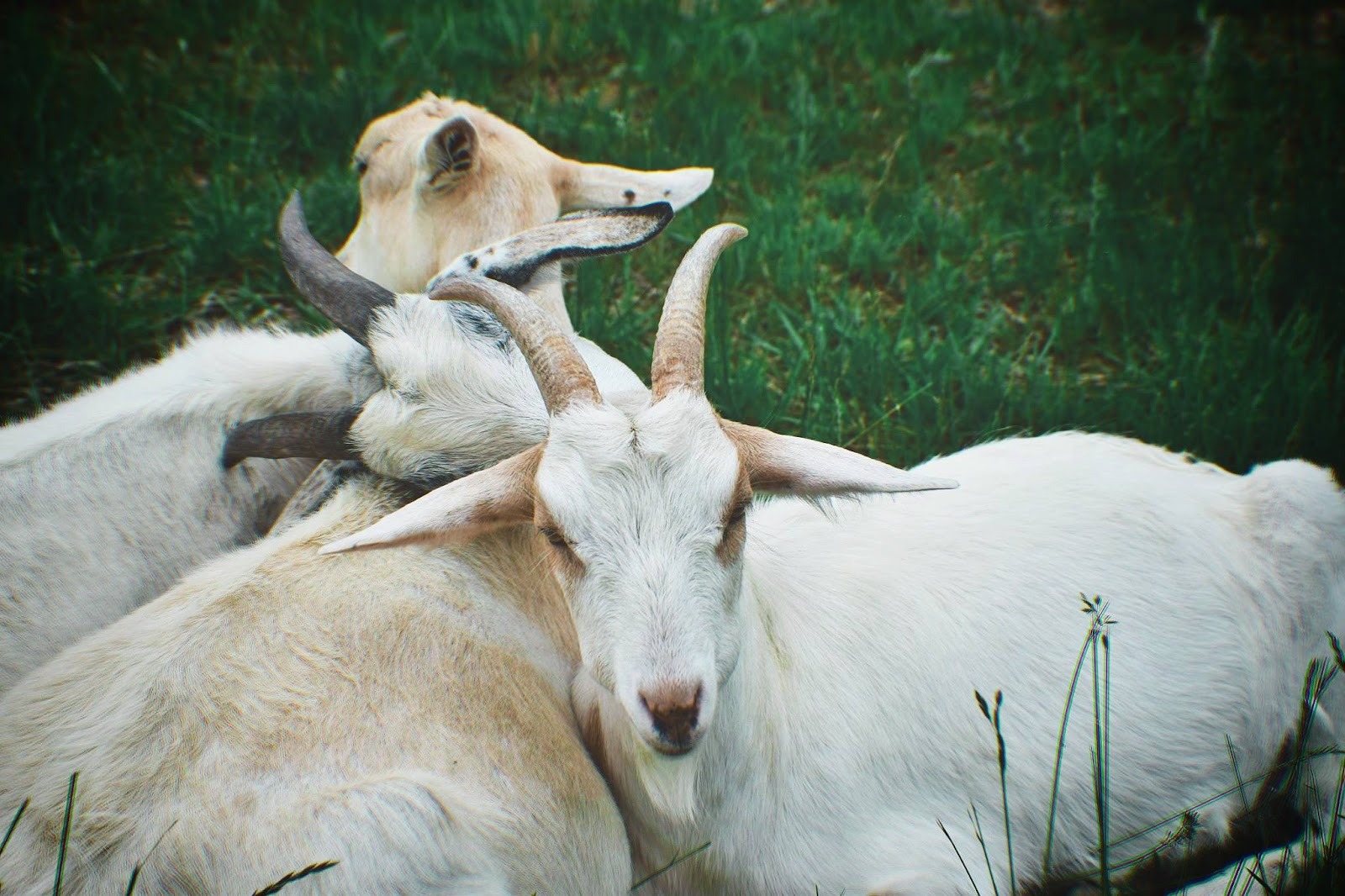
Sweet Mama the Goat with her two children, Ace and Ivy
She touched a lot of people’s hearts, and I think a lot of people don’t know some of those realities about the dairy industry, and they don’t think about goats when they think about dairy and how they’re just as impacted as cows are. So she was a pretty special individual.
Fields: What were the names of her children?
Braford: Ace and Ivy.
A boy and a girl.
Fields: Wonderful! She got one of each.
Braford: That’s right.
Well, thanks again for having me.
Fields: It was a pleasure.
Leave a Reply