

While attending Oberlin College in 2007, Lenore Braford transitioned to veganism. She gained experience as a volunteer, intern, and staff member at multiple animal sanctuaries and then founded Piedmont Farm Animal Refuge in 2012. She currently serves as the sanctuary’s Executive Director and Animal Care Director. Braford recently spoke with me about the college debate that convinced her to go vegan, the principles foundational to a successful animal sanctuary, and the contribution farm animal sanctuaries make to the animal rights movement. Below is our interview.
This post’s featured image is Lenore Braford interning at Farm Sanctuary.
Dynestee Fields: What was your catalyst for transitioning to veganism? Was there an experience that influenced your decision?
Lenore Braford: Well, when I was in college, I was an environmental studies major.
I was taking a class on environmental philosophy, and in the class, I was assigned to be part of a two-person debate, where I would debate that it was ethical to eat animals and animal products, and the other student would debate that it was not.
Through that class assignment, I did a lot of readings. I was trying to search for
ethical arguments to do this, and basically through that process, I convinced myself to become vegan. It’s something that I wish everybody could go through, because in our society, we don’t really think about these things on a deep level, and that assignment gave me the opportunity to do that. So, I like to say that I might have lost the debate, but the animals won in the end.
Fields: Wonderful. That’s a really concrete story.
I noticed on your bio, on the Piedmont Farm Animal Refuge website, that you worked with special needs individuals, and that also contributed to your care for animals. Can you explain?
Braford: Sure. Before I started working with animals, and then later farmed animals specifically, I spent about 10 years, starting when I was in middle school, volunteering and then working with children with disabilities. I just have always wanted to be in sort of a caregiving role and to advocate for individuals in our society who may not have the same advantages as some of us do, and so I think that there’s a lot of similarities in what I was doing and the reasons that I wanted to work with those children and now what I’m doing with animals.
Fields: Perfect. Before founding the Piedmont Farm Animal Refuge, how were you active in the animal rights movement?
Braford: Before I started to learn about animal sanctuaries and start that journey, I wasn’t particularly active myself. I became vegan, first vegetarian and then vegan, in college…I started to learn about this concept of a farm animal sanctuary, and that’s when I spent the next 5 years on staff, and doing internships, and volunteering at as many animal sanctuaries as I could because it was something that I thought I wanted to do. But of course, having no experience, it’s a huge undertaking, and it’s a huge commitment.
So, I wanted to learn. I wanted to see what it was really like, and those were extremely important years for me in terms of being able to then go on and start the Refuge.
I think I have been involved now over the years in various types of animal rights activities: speaking, and going to different demonstrations and protests, and doing things with the SAVE movement. Everybody is able to contribute in so many different ways within the animal rights movement, which I love.
I think, for me, some of those types of activities where you’re maybe coming face-to-face with the industrial agriculture movement, and you’re not really able to do anything in that moment to help those animals, that can be hard for me on an emotional level. It can kind of set me back and make me not as active. So I’m grateful for people who do that and are able to, and I’ve learned that I do a lot better if I’m able to be on the positive side of animals who are coming out of that system. Maybe they come to us with physical and emotional trauma, but we get to be on the helping end and say, “Now you’re safe, and what can we do to help you live as long, as healthy a life as possible?” That gives me energy, and it gives me motivation to keep doing the work I’m doing.
Fields: Would you mind sharing some of the places you worked, some of the animal sanctuaries, and if you have an experience that was really transformational that occurred at one of the sanctuaries or during your time in animal rights activism, could you share that?
Braford: Sure. I volunteered at a small pot bellied pig rescue called Pig Pals, here in North Carolina.
I did internships at Farm Sanctuary in Upstate New York, and also at Woodstock Farm Sanctuary in Upstate New York. Here locally in North Carolina, there weren’t a lot of other opportunities to work with farmed animals, but I did start working with some big cat sanctuaries and ended up working on staff as a caregiver at one. That was really interesting because there’s a lot of differences, of course, between those animals who are wild [and farm animals]. You shouldn’t be touching them; you can’t touch them. From a medical perspective, it’s a lot trickier than farm animals.
There’s so much crossover. I learned so much, not only just about how animal sanctuaries run but also the ins and outs of running a nonprofit organization. One of, I remember, the big learning lessons when I was working at Carolina Tiger Rescue here in North Carolina was we were told as staff about this case happening in Minnesota, where there was a large, big cat sanctuary, and these people were unfortunately relying on one donor for almost all of their funding. I can’t remember the details of why, but this donor was no longer able to contribute, and they were looking to rehome their cats. We were able to take some at Carolina Tiger Rescue, but unfortunately, the vast majority of them simply had no place to go. Some of them had to be euthanized as a result. So, for me, as a founder, as an executive director, as somebody ultimately responsible for the animals in our care, that really left a strong imprint on me that, I’m gonna set my group up so that we’re sustainable over time for the staff, for the volunteers, but most importantly for the animals in our care. When we take them in, we are giving them a promise that they are living here for life.
It might surprise some people to learn that that can be a really long time. For cows, they can live up to 25 years, and geese can actually live up to 40 years of age. So it’s a really big commitment, and we take that really, really seriously here at the Refuge.
Fields: That was a very important lesson.
I also had no idea that geese could live that long.
Braford: I know. Isn’t it amazing?
Fields: That’s fascinating.
Your response directly feeds into what prompted the Piedmont Farm Animal Refuge’s founding. You said that you worked in sanctuaries, and you were thinking, “Hey, that’s something I would be interested in.” But was there a particular moment or story that prompted your actual sanctuary’s creation?
Braford: When I started to volunteer and work at other sanctuaries, I had this idea that I wanted to start my own. I think that idea and that question, it was really strengthened when I was at some of these other farm animal sanctuaries and I got the opportunity—on my time off, or in passing—to witness people visiting through a tour, even people volunteering, and witnessing the impact that the animals can have.
That was really moving to me, and it just really affirmed my belief that this was really an important thing to do. Because not only are we able to rescue individual animals and provide them a loving home, which is so very important for farm animals in this world, where there are not very many places where they can truly be safe. But also we are able to educate people.
It’s one thing when you’re standing on the corner handing out pamphlets and trying to get people to learn about the dairy industry. It’s another thing when somebody comes and meets an individual Benny the Cow, and they learn his story of how he would have been killed at a few weeks of age, and his remarkable rescue, and now he’s this towering giant. Nobody’s ever seen a cow this large, and why is that? Oh, it’s because they don’t get a chance to live and grow up.

Benny the Cow with tour guests
And just the power that the animals can have, and breaking down some of those walls and barriers that people put up when they are confronted with some of these truths. It’s really remarkable, and it happens all the time here at the Refuge. But every time I’m so moved by it and amazed at what the animals, just being themselves, and just being happy, and just expressing themselves, can really do to influence people and change people’s hearts.
Fields: Wonderful. So what year did you go vegan, and what year was the Refuge founded?
Braford: Ooh. What year did I go vegan? [Laughs] I’m gonna have to think about that.
So I went vegan in 2007, and the Refuge was officially founded in 2012.
Fields: So it took you 5 years to gather the knowledge and build your own place.
Braford: That’s right.
Fields: Wonderful. Who was the first inhabitant to come to the sanctuary?
Braford: Yes. Our first rescue was a rooster named Robby, and he was living in a community where he was supposed to have been born as a hen. He ended up being a rooster, and roosters were not allowed in the city limits, and it was a co-op where there were a group of people living together, and some of the people at the co-op just wanted to put him in a pot and eat him. And other people said, “Wait a minute. This is not right. We need to find him a home.” Luckily those people won the votes, and they contacted us, and we took him in. He was a little, lonely guy for the first little bit, as our first rescue. But not long after that we rescued a hen named Esmeralda, and they fell head over heels in love with each other.

Robby the Rooster
We used to nickname them “the Lovebirds.” You would see them going around the chicken area together, just doing everything together. He would build her all these nests to try to impress her, and it was really a lovely relationship that they had.
Fields: That’s an amazing story.
You’ve already spoken on this, but what principles specifically guided the Refuge’s formation?
If you had to list them out.
Braford: I think kindness and respect for all creatures, irregardless of what species we are and all of the other things. And just a recognition that each animal is an individual, and they share so much in common with us.
They have emotions, and they’re scared, and they feel pain, and they feel joy. Unfortunately, because of how society treats farm animals, they aren’t really allowed a lot of the joyful, happy things in life. So trying to create a safe space for them and give people an opportunity to meet them.
Many people, including myself, before visiting an animal sanctuary had never truly met a farm animal. If people do meet them, they tend to meet them in spaces where those animals are not feeling safe. So, it might be at places like county fairs or petting zoos. Those are the types of places you might run into a farm animal, for the average person, and when animals are not safe and happy, they don’t express their full personalities. So they can just get labeled as, “Oh, look. They’re just standing there. They’re inanimate blobs.” But when they’re given that freedom, and they truly feel at ease around humans, amazing things happen. People are unfortunately amazed at the depth that they have.
So that was an important thing as well, to just provide that opportunity so someone could actually meet a turkey or a sheep and learn about who they truly are.
Fields: How would you describe the first year of the Refuge, and what were your challenges and achievements?
Braford: Sure. Well, when the Refuge started, we didn’t have any property.
You know, we had to become a nonprofit, and there’s a lot of paperwork, and there’s a lot of forms, and there’s a lot of things to know. We had to form a board of directors, find people in the community who cared about the mission [and] were passionate about what we were doing. We held our first ever event. It was a vegan bake sale, and it was before we had a single animal. We were talking to the community about what we wanted to do and how they could be a part of it, and we were also sharing with people delicious vegan food and showing them how awesome that can be.

Piedmont Farm Animal Refuge’s first vegan bake sale
So yeah, it was a lot of paperwork and trying to just get the word out about what our vision was and what we wanted to do. Then we were able to first initially purchase 16 acres—we now have 45 acres of land for the sanctuary—and slowly start building. When we got our land, there was no existing infrastructure of any kind. So, that means we have to build everything from the ground up, and that includes roads, putting in a well, putting in the electricity, building structures for animals to live in.
In the first couple of years, we raised money and built the first animal house, which was for the chickens and turkeys. Hence Robby the rooster being our first animal. And then, over time, continued to grow.
We’re still growing. In fact, right now, we are in a fundraising effort called The Pig Project, and we have completed Phase 1, which is building a bunch of roads and infrastructure, and we’re now fundraising for Phase 2, which is to build four pig houses, and a pig clinic, and a quarantine, and a feeding area.
Because for us, being able to provide homes for pigs is very, very important—a lot to do with where we’re located here in North Carolina because North Carolina ranks number three in the country for number of pigs raised for the food industry. That industry here in our state has massive negative effects, not just for the pigs but for people and also for our environment. So, it’s very important for us to be able to not only save pigs and provide them with a loving home but have the opportunity to talk to our community about these issues and how they affect all of us, not just the pigs.
So that’s kind of been our motto over time: don’t build it all at once, grow slowly, grow sustainably. Make sure we’re going to be here for these animals that are in our care now and into the future.
Fields: I’m not sure if it’s true of all sanctuaries or just yours, but I guess when most people think about a sanctuary starting, they think about the animals coming first. But it took you all a couple of years to get to that point, and that is a wise decision when you think about it.
Braford: Yeah. I would never take an animal in before I had a proper place for them to live and where they would be safe from predators, and I would have at least some volunteers on hand to be able to help care for them and all of that.
It doesn’t always start like that, and I think, probably it was those years at other rescues that kind of put into my mind: “Okay, we gotta do this the right way. There’s an order of operations.” Even now, and for every sanctuary, we’re all getting contacted and called every single day about animals in need. That’s not going to stop anytime soon. So, yes, there’s always an urgency to rescue quickly, and rescue as many as you can. But in the end, if you’re not setting up your rescue to succeed and to be sustainable, then you’re going to be closing your doors in a few years, and that’s not helping animals.
That’s why that’s always been really important to us. Especially in some of the more recent times, through COVID and some other struggles. It was really sad to see a lot of farm sanctuaries shut their doors. We ended up taking in animals from some of those sanctuaries. It’s just, again, a matter of making sure you have sustainability built in for your revenue streams and everything else. It can be hard because when you’re getting called about animals all the time, you want to say “yes” to all of them, because you’re a human, and you have a heart. That’s why you got into this work. But if you do that, you kind of set yourself up for being overrun and not being able to provide the right amount of care.
So, I’d say that one of the hardest parts about my job is having to say “no” when you want to just say “yes” to all of them.
Fields: That makes sense. A follow-up to what you just said: what circumstances do the Refuge’s animals come from, and how do you determine who you will admit?
Braford: Yeah. The decision for how we decide, “Oh yes, we can say “yes” to this case,” or we have to say, “Unfortunately, no” to this—it’s not just about space. A lot of times, people think maybe it’s, “Oh, it looks like you have room.” It’s also about, well, mostly woman power. Who’s here to provide care, and what kind of level of care is that gonna be? Also, of course, finances, and then also, of course, how will it affect animals that we already have in our care?
There are sometimes challenges where, for example, some male animals don’t like to get along with other males. So we’ll max out for number of roosters because they just don’t play well together. Things like that. So sometimes, even the small details of what animal is in need could affect whether or not we can responsibly take them in. But they’re coming from all sorts of different situations.
Many of them come directly out of the industrial agriculture system, and that can happen a number of ways. There can be accidents on the road or animals that leap from trucks and are found later on the side of the road. There can also be animals who are relinquished.
In fact, some of our very first chicken residents came to us from across the country in California, where a former egg farmer decided, “I don’t want to do this anymore, and I don’t want to send my last group of chickens to slaughter. I want them to go to a rescue.”
Well, there were about 2,000 hens in that house because that’s how they’re kept in industrial settings. As you can imagine, the local California sanctuaries could not accept that many hens, and so they [hens] went on a journey, and they actually made national news. People thought it was funny, I guess, that chickens were being flown on an airplane. But it got the word out about how they were being raised, and where they were headed, and this idea of a farm animal sanctuary.
We also have a family of four cows who came from Oklahoma. They came from a former beef farm. Through working with these cows, the farmer and his wife fell in love with them and realized they’re not that different than dogs. They could not bear to send a single other one of them to slaughter, and they decided they wanted to find safe homes. So, again, it was a large number of cows who needed safety. They started to go all over the country, and we were able to take in that family.
We also work with a lot of law enforcement and animal shelters for cruelty cases, locally and nationally. Then a lot of individual people might just find animals; animals find themselves homeless. We’ll never know where they originally came from. We’ve gone out on a lot of rescues where we park our trailer in very nice people’s backyards to try to help a wandering goat or a wandering turkey who needs a safe place to land.
Fields: That’s all fascinating.
You were talking about the chickens from California and how the news got out. It’s always interesting how when an animal jumps from a transport truck, people are very concerned about that animal. It makes the news, but they don’t take a second to think about, “Hey! I was contributing to that animal traveling to be killed.”
Braford: Yeah. That is a great point. I think that’s like a psychological concept, right? The power of the individual, right?
Like, when we hear there’s so many millions of cows who are killed every year, that doesn’t really impact us. But when we hear one cow’s story—you know, the story of Benny, and here he is, and there’s his personality—that can make an impact. And so, I think that’s another thing that is a really strong point that sanctuaries bring to the table in the animal rights movement: we do have those individual stories, and sometimes that can make a much larger impact.
Fields: That’s wonderful. Now let’s get into the day-to-day lives of the animal residents. So, what does day-to-day life look like for them?
Braford: Sure. For almost all of our residents, except the cows, they’re gonna be sleeping overnight in predator-proof houses.
They’ll wake up and kind of get their day started, stretch, and then shortly thereafter, they’re going to hear a caregiver arrive and start to open up their house to start their day. Many of our residents will start the day with breakfast, so they’ll have their food put out for the morning. Their fresh hay. They’ll get let outside where they can start to forage in the grass or in the woods and just kind of do their thing. Some of our residents might get special medications. We like to give them in Fig Newtons or other yummy treats if we can, just depending on their age and what they’re dealing with.
Every morning, as well, the animals here will be provided with some kind of enrichment.
Those are things to keep them from being bored, and we like to try to rotate through all of their senses. So, one day we might put on some relaxing music for them to listen to. Another day, we might spray an interesting scent around their environment for them to investigate. Or we might put treats inside of a rolling puzzle feeder that they are gonna work on for hours to get all those little raisins out, or whatever it is that they’re excited about.
Then they get to spend time with each other and also with humans, if they so desire. Many of our residents do seek out and enjoy affection from the caregivers and volunteers that work here. So whether it’s getting brushed if you’re a goat or a cow, or getting some nice pets or scratches if you’re a chicken, they will often seek out some of that affection.
Then, of course, in the evening, everybody will get safely brought back inside for night, tucked into bed, and just made sure that they’re safe and well for the evening.
Fields: First, I want to ask if you can list the different species that are present? I know you discussed it earlier, but is there a comprehensive list?
Braford: Yeah. We have rescued goats, sheep, chickens, turkeys, ducks, geese, cows, one guinea fowl—named Frizzle—and we are working to rescue pigs in the future.
Fields: Wonderful.
It sounds like most of the animals that you described are comfortable around humans now. That’s a bit of a shock, considering that many of these animals came from places where humans were threatening to them.
Braford: Yeah. That’s something that’s important here, that we make sure animals always have the choice [to interact with humans or not]. If it’s a visitor day or something like that, and they are a shyer individual, or maybe they’re more newly rescued, and they’re not as comfortable around people yet, or maybe they just don’t feel like hanging out, they can move away and have their own private space.
But, yes. For most of the animals here, they learn from us but also from their fellow animals. They learn a lot from each other, and they feel the sense of calm and the sense of relax that surrounds them. That gives them a signal that, “Oh, this is a safe place, and I can relax here.” It’s amazing. It is truly amazing to see them heal from some of those past experiences and forgive humans for what they have done. I think that’s a beautiful lesson that we can learn from animals about moving forward in life no matter what you’ve experienced and just going forward with positivity.
Fields: That’s incredible.
So, is there an animal whose experience has become mythic for the sanctuary?
Braford: I wouldn’t necessarily say mythic, but I think one of our residents whose story has been particularly impactful over the years has been a goat named Sweet Mama. She is an amazing individual who originally was born on a dairy farm, and after 5 years or so of milking, her body started to wear out. She no longer was producing milk at the level that the farmers needed, and she was sent to a slaughter auction, like most of those animals in dairy farms are.
But she managed to somehow escape, and she ran across the road and was hiding out with some cows on a nearby farm. That’s when this woman noticed her. This woman was coming to that farm to actually care for a group of feral cats, and she said, “Well, what is this goat doing here?” She got the farmer’s permission to start feeding her [Sweet Mama] and taking care of her. Well, one day she arrived and found this goat giving birth.
She ended up giving birth to twins. These were twins she was pregnant with when she was sent to slaughter. So she not only saved her life, but she saved the lives of her children. At this point, this little goat family needed a safe home, and so they all came to the Refuge. Sweet Mama was very wary of us and was stamping her foot at us and standing in front of them [twins]. She didn’t know anything different after years of having babies born and quickly taken from her.
But then she, over the week, started to settle in [and] realized this place was a little different. It was truly wonderful to see her get to nurse, and raise, and keep her babies for the very first time.
She was such a strong-willed goat, and her adult children, as they grew up, they would snuggle with her every day out in the pasture. We would use to refer to them as the three-headed goat, because it looked like one goat with three heads because they were so snuggled up. Just the love that they had for each other and the opportunity for her to finally have a family was so amazing and so special to watch.
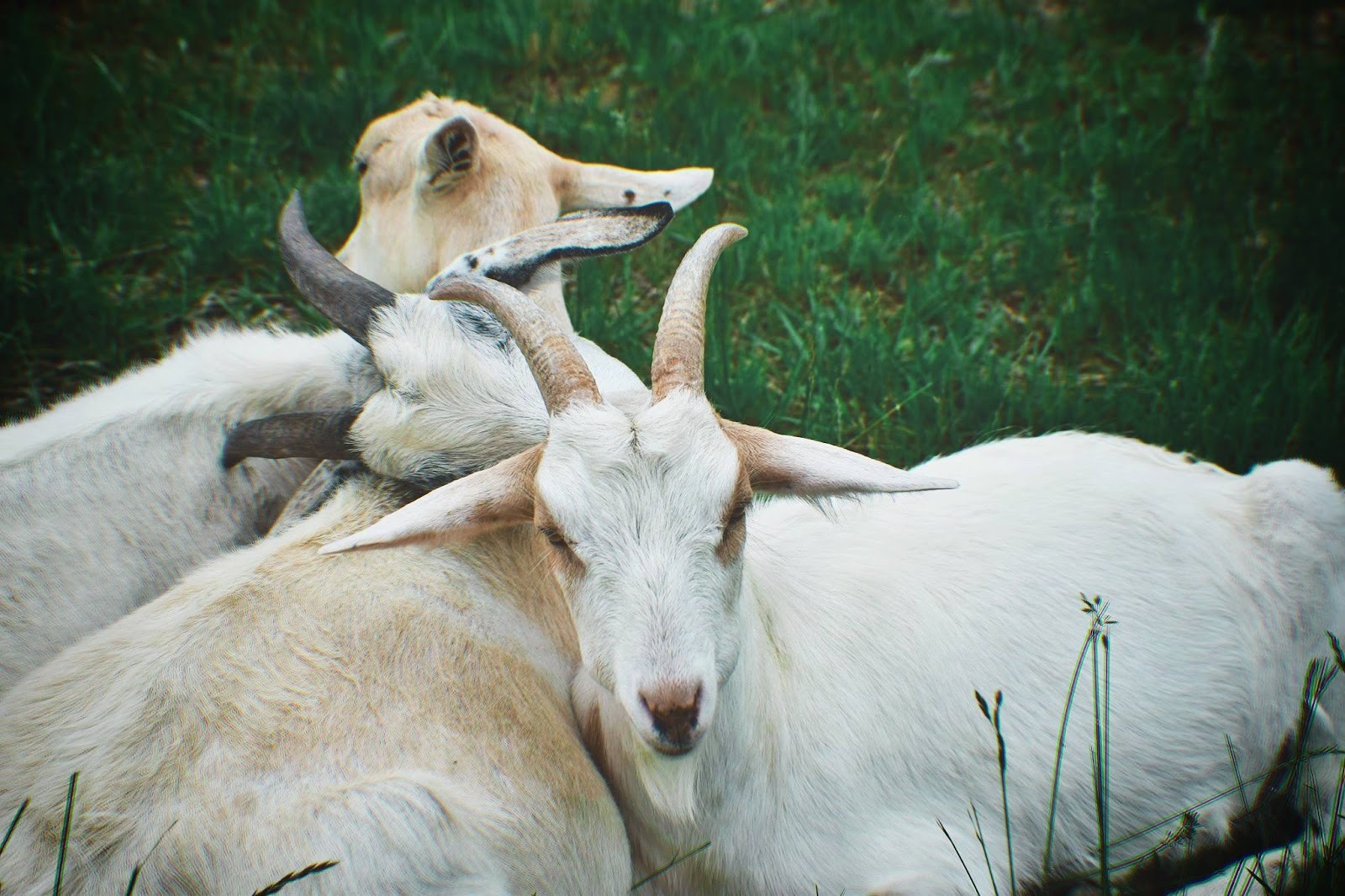
Sweet Mama the Goat with her two children, Ace and Ivy
She touched a lot of people’s hearts, and I think a lot of people don’t know some of those realities about the dairy industry, and they don’t think about goats when they think about dairy and how they’re just as impacted as cows are. So she was a pretty special individual.
Fields: What were the names of her children?
Braford: Ace and Ivy.
A boy and a girl.
Fields: Wonderful! She got one of each.
Braford: That’s right.
Fields: So what community outreach initiatives does the Refuge organize, and how are these chosen?
Braford: So, we have a large education program. We, of course, will have tours and visits at the sanctuary where we have an amazing team of volunteer tour guides who will tell you all about the animals’ stories, their names, as well as really interesting facts that most people don’t know about farmed animals and can help us learn to appreciate and respect them.
We also will have vegan cooking classes at our sanctuary and out in the community where we partner with local cooking instructors, and we just try to do a variety of different classes to really show people the wide variety of food that you can have if you are living a vegan lifestyle.
We will have some film screenings. We have a summer camp for children called Camp Compassion, where they get to learn about and take care of our animals, and we also partner with a vegan chef, so the kids will actually make their own vegan lunches every day as part of the camp program.
We have free field trips for students of all ages to make sure it’s accessible for schools to come here and have that experience. Yeah, and more. We really believe that a lot of these issues that these animals face, we can’t solve those issues by rescuing. The problem is just too large. It’s too vast.
And so, we want to utilize our location to reach as many people as we can, so that they can learn, they can be inspired, they can meet other people who can help them. If they do want to make choices that are more friendly towards our animal friends, that they are equipped with the information and the community to do that.
Fields: Was this education-based strategy born at the same time as the Refuge, or did it come later?
Braford: Yeah. It was born at the same time. As I mentioned, our first event was a vegan bake sale, and we had cooking classes in the early days. So yeah. Right from the get-go, we knew that that was going to be an important part of our mission and what we were accomplishing.
Fields: Excellent. What is a moment from a community event that remains with you?
Braford: We just had a screening of a documentary that was actually made all about our sanctuary, called Forever Home, and right now, this documentary is going to film festivals, and people can also have community screenings of it if they wish. And the website is foreverhome.love, which I love. So, for the first time, this documentary has really been sort of a grassroots effort. It’s been over 5 years in the making of it, and it’s finally done, and we showed it here at the Refuge for the first time for our community, just a couple weekends ago. We had a huge turnout, and it was just such a wonderful event where it felt like kind of a thank you to all of our local supporters and volunteers. We’ve been around for almost 14 years, and we have some volunteers who’ve been with us almost that long, and it just felt like a big hug, and it just felt like a moment of celebration for everything that we’ve done and for all of the animals that have been part of our community as well.

Piedmont Farm Animal Refuge’s first screening of Forever Home
Fields: Is this documentary available for viewing elsewhere?
Braford: No. Right now, like I said, it’s going to film festivals. Through that website, like, if you’re part of a church or some kind of community group, you can request a screening. So that’s how you can see it at the moment, and then it’s going to go into its next phase, and eventually it’ll be more available. But it’s very, very new, so it’s sort of just newly released.
Fields: Excellent.
So, does the Refuge work nationally to change perspectives and treatment of farm animals? A little while ago, you talked about how some of the chickens came from California. So you collaborate with animal rights activists and organizations outside of your own?
Braford: Yeah. A lot of our animal rescues come from North Carolina, but many of them come from out of state. We have some sheep who came from a butchery that was shut down in New York, and I mentioned the cows from Oklahoma and the chickens from California. Also, through our online work, we reach people all over the country and all over the world. So through social media and through our website, we’re able to tell those stories and really amplify our reach in that way.
We love to work with other sanctuaries all over the nation. I have some solid connections with some of them from my previous internship work, and we started this program, called Sanctuary Swaps, where we will partner with another sanctuary. We will send some of our staff over to them for a couple of days to learn, and then they’ll send some of their people over to us.
It’s a really nice way to see how other people are doing the work and also have a sense of connection and solidarity because sometimes it can feel kind of isolating or alone to be in the world and be advocating for animals when there’s not a lot of other people out there doing that.
So yeah. That’s another way that we work with other sanctuaries and just continue that learning process.
Fields: Wonderful. I believe I also saw you all interacting with We Animals Media?
Jo-Anne McArthur’s organization that takes photos of animals who are in crises?
Braford: Yeah. Absolutely. So, there’s a couple of photographers through We Animals who we know and love, and Jo-Anne herself visited us earlier this year and got an opportunity to bring her camera around the sanctuary and take some pictures.
I think the story of one of our residents, Sweet Pea, who came as a tiny chick, was also featured through We Animals. So, yes. We’ve been very fortunate to be in connection with them and all of their talented photographers.
Fields: Excellent! What has been the Refuge’s greatest impact?
Braford: I mean you could say a lot of things, but I think that the value for the individual residents is probably the most important. You know, [that value] takes me back to that starfish story, where it’s like, “Oh, you can’t save them all, but it means everything for that one that you’re able to save.” I feel that way, for sure, because each of the animals here is so different, and is such an individual, and has their own life. Whatever that story has been for them, and getting the chance to live in a place where they are loved, and valued, and respected, and get to be around others of their kind. I mean, there’s no kind of value you can put on that. I think that that is what I would say is the most important thing that we are doing.
Fields: Excellent. Is there anything you wish more people would ask about your work or about the Refuge?
Braford: Well, I think for most people they’ve probably never visited an animal sanctuary before. Maybe you’ve been to a zoo, or a petting zoo, or a farm, and so I would love people to be curious and be open-minded. You know, what is an animal sanctuary? You know, what does it mean? What does it mean to have a sanctuary for farm animals? We’ll often hear, like, from someone, “Oh, I didn’t even realize that, like, a chicken needed to be rescued.” So it’s this whole other world, right, of how these animals are being treated in the industrial system, how most of them are living. It’s so very hidden from our society. So, when we’re able to be curious and learn, well, what does this mean, that a farm animal sanctuary needs to be in existence?
That starts to really kind of take the blinders off and just starts us down a path of deep learning and understanding about what it means to be a farm animal in our world, in this day and age, and why a sanctuary would be so important for them.
Fields: Thank you for sharing that.
Braford: Well, thanks again for having me.
Fields: It was a pleasure.
Leave a Reply