

Lenore Braford lost a debate in college but considers that a victory. As an environmental studies major, she was tasked with defending the ethics of eating animal products in her environmental philosophy course; her debate partner would argue the opposite. To prepare, Braford “did a lot of readings.” But the more she read, the more she became convinced of the opposing argument: the truly ethical stance is to abstain from eating animal products. Braford explains that “basically through that process, I convinced myself to become vegan.” She now wishes everyone had the opportunity to think deeply about the ethics of eating animal-derived food. Doing so might transform one’s own life and the lives of countless animals. Of her life-altering debate assignment, Braford says that “I might have lost the debate, but the animals won in the end.”
After becoming vegan, in 2007, Braford started exploring the animal rights movement and found that animal sanctuaries are where she finds fulfillment. She applauds that, within the movement, there are opportunities for everyone to contribute. She’s particularly grateful for people who engage directly with industrial agriculture and who work with animals who can’t be rescued from that system. Sanctuary work still brings her face-to-face with trauma, but she is directly able to help animals heal from this. “Maybe they come to us with physical and emotional trauma,” Braford explains, “but we get to be on the helping end and say, “Now you’re safe, and what can we do to help you live as long, as healthy a life as possible?” That gives me energy, and it gives me motivation to keep doing the work I’m doing.”
Since Braford could see herself working in this community, she became a staff member, intern, and volunteer at multiple animal sanctuaries prior to founding Piedmont Farm Animal Refuge in 2012. She knew that sanctuaries are a “huge undertaking” and a “huge commitment” and wanted to gain as much experience as possible. She spent time at Pig Pals and Carolina Tiger Rescue in North Carolina and Farm Sanctuary and Woodstock Farm Sanctuary in Upstate New York. Her time at Carolina Tiger Rescue was particularly impactful, educating her on the role responsible planning has in sanctuary success. Unfortunately, a large, big cat sanctuary in Minnesota found itself on the verge of closing. While Carolina Tiger Rescue was able to offer some of the cats a home, most of them had no place to go. Sadly, some were euthanized. “These people [in Minnesota] were unfortunately relying on one donor for almost all of their funding,” Braford reflects, “but this donor was no longer able to contribute.” Seeing this, she knew that sustainability for animals, staff, and volunteers would be foundational to any sanctuary she founded.
Chickens, ducks, geese, turkeys, goats, sheep, cows—and even one guinea fowl—now call the Refuge home. As its founder and Executive Director, Braford is currently overseeing a fundraising effort called “The Pig Project,” which will eventually allow the sanctuary to house rescued pigs. She emphasizes that being able to provide homes for pigs is especially urgent: “a lot to do with where we’re located here in North Carolina because North Carolina ranks number three in the country for number of pigs raised for the food industry.” Rescuing pigs would not only help these animals but also spark conversations about the toll of industrial pig farming on humans and the environment. While the Refuge could distribute this information using pamphlets, Braford finds that introducing people to living, individual animals better educates them on industrial agriculture. Benny the Cow’s story provides an illustration: “They [visitors] learn his story of how he would have been killed at a few weeks of age, and his remarkable rescue, and now he’s this towering giant. Nobody’s ever seen a cow this large, and why is that? Oh, it’s because they don’t get a chance to live and grow up.”

Benny the Cow with tour guests
Education was always part of the mission. Braford notes that, prior to the Refuge having any animals, they held a vegan bake sale to share “with people delicious vegan food” and show “them how awesome that can be.” The Refuge’s educational initiatives have expanded throughout the years and now include vegan cooking classes led by local instructors; sanctuary tours and field trips; Camp Compassion, a summer camp for children; and recently, a documentary titled Forever Home, which explores the sanctuary’s animal-centered design and dedication to meeting the needs of each animal resident.
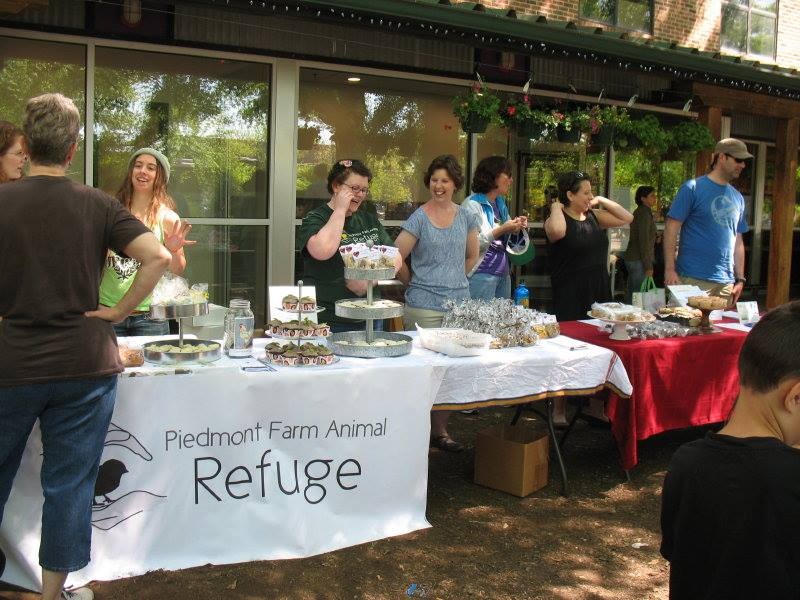
Piedmont Farm Animal Refuge’s first vegan bake sale
Braford’s wish, that everyone would have the opportunity to think deeply about consuming animal products, is at the heart of each of these initiatives. Farms, county fairs, zoos, and petting zoos are the dominant locations where people encounter farm animals. These are places where “animals are not feeling safe,” and when they don’t feel safe, “they don’t express their full personalities. So they can just get labeled as, “Oh, look. They’re just standing there. They’re inanimate blobs.”” Sanctuaries offer a counter perspective. “When they’re given that freedom, and they truly feel at ease around humans,” Braford says, “amazing things happen. People are unfortunately amazed at the depth that they have.”
This post’s featured image is Lenore Braford interning at Farm Sanctuary.
Lenore Braford went vegan in 2007 while attending Oberlin College. She currently serves as Executive Director and Animal Care Director at Piedmont Farm Animal Refuge, which she founded in 2012 to provide a forever home and excellent care for rescued farm animals. Before advocating for animals, Braford spent nearly 10 years volunteering and working with children with disabilities. Through that work, she discovered her calling as a caregiver and advocate for vulnerable populations.
Leave a Reply