
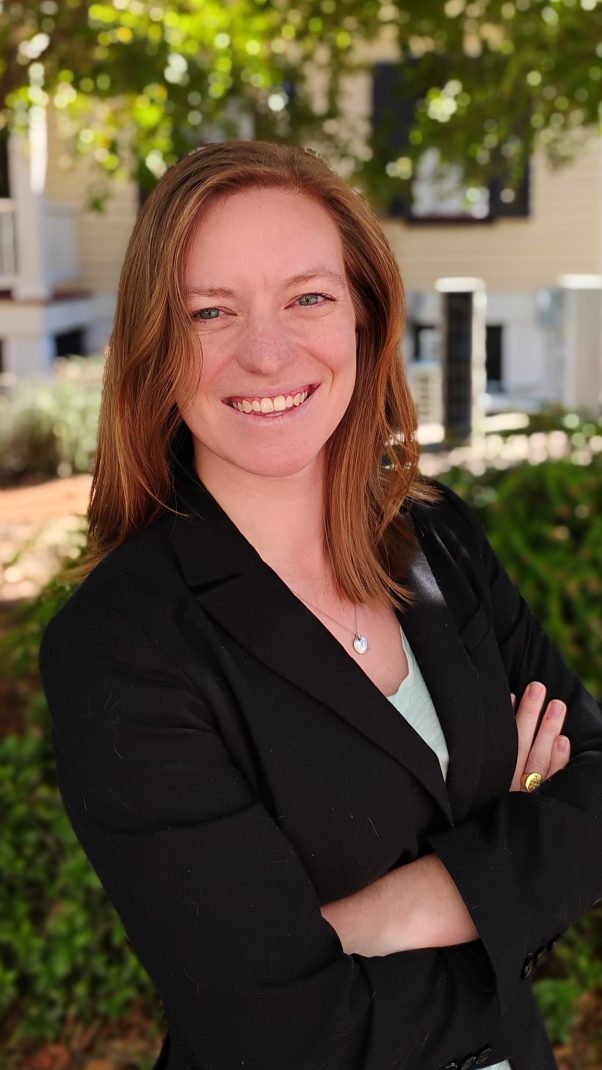
Morgan Mercer, a third-year law student, revived the University of South Carolina’s student chapter of the Animal Legal Defense Fund [ALDF] in 2023. Formerly an elementary school teacher, Mercer is passionate about bringing justice to corporations and individuals that use their wealth to evade accountability and exploit the vulnerable, including nonhuman animals. Using tabling, Lunch-and-Learns, and animal visits, Mercer and the Student Animal Legal Defense Fund [SALDF] educate fellow law students on issues impacting animals across the U.S. legal landscape and on how to anticipate animals emerging in their legal careers. Our complete interview can be read here. Below are some highlights from our conversation.
Dynestee Fields: In what ways do you see yourself engaging with the law in your career? What experiences have influenced your career path?
Morgan Mercer: I definitely see myself doing some of the more niche parts of the law that not a lot of people do.
I also am really interested in criminal prosecution of crimes that don’t get a lot of attention. So white-collar crimes. Or, child pornography is another big one that some of these local, prosecuting offices just don’t have the time and resources to invest in these crimes because they’re very time-intensive.
I guess the things where I feel like people are being exploited by the system, those are the things that I see myself going to fight, whether through civil litigation with these mass torts and pollution lawsuits or through the criminal side.
I get really frustrated when I feel like people who have money—the laws are different for them. So I kind of see myself as enforcing the laws against people who have money, if that makes sense.
Fields: How did you become interested in animal law? You’ve mentioned pollution and white-collar crimes. How did you pivot in this direction?
Mercer: I think a lot of it is all connected to me—that it’s generally the same group of people who feel like they are above the laws, and the laws don’t apply to them and kind of put money over people.
So the same corporations who are polluting rivers are the same ones who support ag-gag laws.
There is [also] some overlap between white-collar crime and dogfighting rings.
So that’s where my interest started. I didn’t have this really cohesive view of what I wanted to do in the law, but animals touch every type of law there is. So it was a really good way for me to explore “Do I like criminal law? Do I like courts? Do I like contracts? Do I like big business?” Animals are everywhere, and so the legal system has to accommodate for that.
Fields: Before your chapter of the Student Animal Legal Defense Fund, was there much focus on animal law at the University of South Carolina?
Mercer: There is an animal law class at South Carolina, and it existed prior to SALDF, [and is now] kind of re-emerging on the scene. The animal law class here started in the Fall of 2023.
I think I restarted the chapter also in the Fall of 2023, so I guess they kind of coexisted at the same time.
We rely on the professors [Elle Klein and Jane Taylor] who teach animal law pretty heavily to help us get speakers and things for some of our events. So the animal law class started unrelated to SALDF, but we work with that class really closely.
Fields: The Animal Legal Defense Fund uses the legal system to nationally protect the interests of animals. Can you describe how your student chapter interprets and implements the ALDF’s mission at the local level?
Mercer: So we look at ALDF’s five categories of animals. So it’s companion animals, wildlife, animals in research, farmed animals, and captive animals is the fifth one.
We look at those five categories, and then we pick events that fall into one of those five. Which is pretty broad, which is nice.
But we’ll say, “Hey, we’ve done a lot of things that fall into this companion animal category. Let’s look at something that has to do with wildlife. Now we have an event in November about wildlife.”
Or, “We don’t do a lot with farmed animals. Let’s do an event with farmed animals.”
So we use those five categories of ALDF’s mission as a way to structure our own activities to make sure that we are giving a really good range and breadth of information to all the students here.
Then they [ALDF] do seasonal campaigns and things. October is Farmed Animal Awareness Month, and so in the month of October, we’ll do things in conjunction with some of their events. So those are the big things.
Fields: Okay. What is something you’re doing this month [October] that aligns with Farmed Animal Awareness Month?
Mercer: So we set up a table, kind of in the main lobby of the law school.
We just call it tabling, which is a very creative name [laughs], and we give out information about ag-gag laws and pig gestation crates. So we have this really bright neon orange masking tape, and we put it on the ground in the size of what a pig gestation crate looks like.
We’ll try to bring people in and talk about the conditions for pigs that are being raised for slaughter and what this means and ag-gag laws.
So we use these tabling events as a way to try to spread awareness about some of these things, especially because South Carolina is such an agricultural state that these things are not distant issues. They’re happening here.
Fields: That’s a very vivid example. I’m sure that that captures a lot of attention.
Mercer: It does. There are a lot of people who lay down in it.
Fields: What area of animal law is your team most passionate about serving this year?
Mercer: I think the one that we focus on most is definitely animals in criminal law. So prosecution of dogfighting or cockfighting, looking at the link between animal abuse and then human abuse or crimes against human individuals. Of the members on the executive board, that’s what we all see ourselves doing professionally. So that’s kind of our focus there. We are trying to push ourselves a little bit this year to look at what we think of as working animals. So horses that aren’t just someone’s companion, but carriage horses in Charleston.
I love horseshoe crabs in that category a little bit, just because they are used in medical research, and they are not technically killed. I mean, the research does have a really high mortality rate for the horseshoe crabs. So that’s kind of what we’re trying to push ourselves to do this year, is look at animals that are being used to benefit humans in a slightly different way than what people might think.
Fields: With horseshoe crabs, can you elaborate on your interest in them?
You said it’s because they’re used in medical research, and they’re not necessarily killed, but there’s a high mortality rate.
Mercer: I believe there are only three states that have these horseshoe crab facilities. South Carolina being one of them.
It might not be three, but it’s a very, very low number, and South Carolina is one of them. So what they do is they go and dredge up horseshoe crabs that are naturally found in the wild. They take them to a lab, and then they take this really, really thin needle, and they stab them through the heart with it, and then drain about 50% of their blood.
Then they dump them back out in the ocean. So they don’t technically kill them, but draining anybody of half the blood in their body is not gonna be good. So there’s a really high mortality rate for this.
But the horseshoe crab blood is used in a lot of really important medicines and vaccines and things.
Science hasn’t come up with a synthetic formula that works.
The horseshoe crab blood is necessary to make vaccines and medicines that are life-saving, but also we are drastically damaging the horseshoe crab population by doing this, and it’s an issue that’s really specific to South Carolina because we’re one of only a handful of states that allow this to happen. So I guess that’s part of my interest, is that it’s very local.
But also, it’s an interesting balance of human need for medicine versus this animal’s right to live.
Fields: So in what particular ways does SALDF hope to impact the University of South Carolina, specifically the law school, and the broader world of animal advocacy?
Mercer: That’s a really good question.
I think our main hope is to make people aware of something that they didn’t know existed. We’re not trying to encourage everyone at the law school to become an animal law attorney. But we do want people to think about the way animals may come up in their law practice.
So let’s say you’re really interested in family law, and you are dealing with a couple who’s getting divorced. Let’s say they have companion animals. If you’ve never thought about this before, and this is your first time thinking about it, what do you do with an animal in a divorce? Because people love their animals.
If you’re a tax attorney, and you’re in South Carolina, and someone’s hobby has to do with horses, what do you do with horses and taxes?
I think that’s part of what we want to do: make people think about these things so that when they happen, they’re not like, “Oh my gosh. My client’s so unreasonable. This is absurd.” We’re like, “It’s not absurd. People care.”
Leave a Reply