
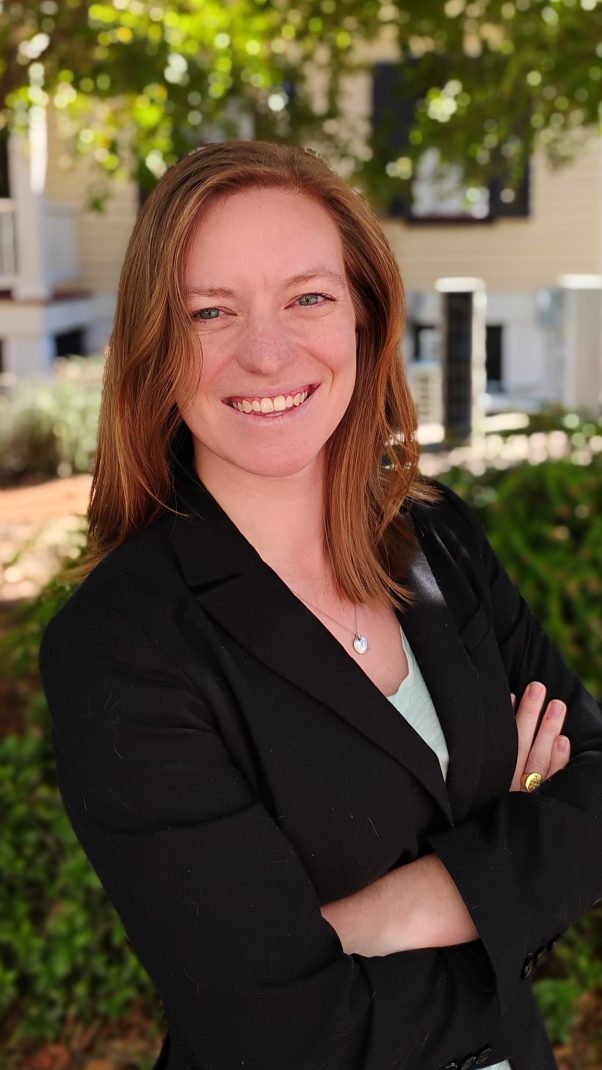
Morgan Mercer, a third-year law student, revived the University of South Carolina’s student chapter of the Animal Legal Defense Fund [ALDF] in 2023. Formerly an elementary school teacher, Mercer is passionate about bringing justice to corporations and individuals that use their wealth to evade accountability and exploit the vulnerable, including nonhuman animals. Using tabling, Lunch-and-Learns, and animal visits, Mercer and the Student Animal Legal Defense Fund [SALDF] educate fellow law students on issues impacting animals across the U.S. legal landscape and on how to anticipate animals emerging in their legal careers.
Dynestee Fields: How did you first become interested in law, and was there a particular experience that ignited your interest?
Morgan Mercer: So I became interested in law while I was teaching. I was an elementary school teacher for 5 years right after graduating from undergrad, and while I was teaching, I saw all of these things that were impacting the student’s life outside of the classroom that I didn’t have any control over.
I found that really frustrating. I could be the most perfect teacher in the world, which I wasn’t. But theoretically, you could be the most perfect teacher in the world, and you still can’t control everything that goes into these kids’ lives. You know, if they come to school hungry…if they’re getting enough sleep at night…if…, you know, they’ve lost family members to gun violence.
There’s all this stuff going on that impacts them, and we just kind of expect them to leave it at the door when they come to school.
So I decided that I wanted to do something to address some of those things because there are a lot of really fantastic teachers out there, and so I didn’t feel like me leaving was gonna impact the quality of education for my students.
Law felt like the right thing for me to go try to address or tackle some of those issues.
Fields: That’s fascinating. So your background in teaching informed your future career.
Mercer: It did. We’re still working on how to see that vision through, but that was kind of the catalyst.
Fields: What grade particularly did you teach, or was it just all the grades in elementary?
Mercer: I had first, second, and third grade. So I did third grade for 2 years, first for one, and then I kept that same group of kids and taught them again in second grade, and then I stayed in second grade until I came to law school.
Fields: Wonderful. You had a lot of time to get to know that group.
Mercer: Yeah. I did.
Fields: In what ways do you see yourself engaging with the law in your career? What experiences have influenced your career path?
Mercer: I definitely see myself doing some of the more niche parts of the law that not a lot of people do.
I really like toxic tort litigation; so, that’s some company dumps a bunch of stuff in a river, and now a bunch of people are getting sick, and so lawyers come in and try to sue the company that created all this sickness and illness as a way to try to make up for that loss.
So I really like that type of thing. There aren’t a lot of firms that do that, but that’s kind of where I hope to go.
I also am really interested in criminal prosecution of crimes that don’t get a lot of attention. So white-collar crimes. Or, child pornography is another big one that some of these local, prosecuting offices just don’t have the time and resources to invest in these crimes because they’re very time-intensive.
I guess the things where I feel like people are being exploited by the system, those are the things that I see myself going to fight, whether through civil litigation with these mass torts and pollution lawsuits or through the criminal side.
I get really frustrated when I feel like people who have money—the laws are different for them. So I kind of see myself as enforcing the laws against people who have money, if that makes sense.
Fields: Is there a particular case that you witnessed that really impacted you?
Mercer: So this isn’t an ongoing case. When I was first teaching, I was in this rural town in Arkansas, and there was kind of this running joke that there was something in the water because there were all these weird, unexplained illnesses. Kids would just randomly get nosebleeds on an almost daily basis, or kids had a weird amount of allergies that just didn’t really make sense. The longer I was there, the more I was like, “I think there might legitimately be something in the water. I think there’s actually something wrong here.”
So that’s how that started.
Then the firm where I clerk right now, they have some lawsuits very similar to this that have to do with water pollution. That’s an ongoing case, so I can’t say a lot about it, but it’s been really cool to see the inside of what it really takes to hold these companies accountable for the stuff that they’ve been doing.
Fields: Nice. Was there something actually in the water where you were teaching?
Mercer: We still don’t know. No one’s done any chemical testing. It’s a really poor area, so just no one has the time or the resources to think about that. But there is an old chemical plant that has since been shut down, and so I personally think that when they shut down, they just left and didn’t ensure that any of the chemicals that were being manufactured were properly stored. So I think the plant is just leaking pollutants.
Fields: Wow.
Mercer: Yeah.
Fields: No wonder you have an interest in that side of the law.
Mercer: Yeah. I do. Yeah.
Fields: Moving towards the Student Animal Legal Defense Fund [SALDF], as the president of the organization at the University of South Carolina, what prompted your chapter’s creation?
Mercer: So our chapter is a little bit odd in the sense that it was created and then went dormant during COVID. So it kind of existed on the books but didn’t actually exist.
So when I got to law school, I had read a lot about SALDF chapters all over the country, and so I was really excited to join. So when I got here and found out that it didn’t exist, I started it not exactly from scratch because it had existed. So we had some of the founding documents.
I just kind of restarted it. I guess I prompted the chapter’s creation because I had been looking into student organizations I wanted to get involved in when I came to law school. I went to that orientation fair with all of the student organizations, and it wasn’t there. I was really disappointed in that, and I felt like it needed to be here. So I was like, “I’ll start it.”
Fields: How did you become interested in animal law? You’ve mentioned pollution and white-collar crimes. How did you pivot in this direction?
Mercer: I think a lot of it is all connected to me—that it’s generally the same group of people who feel like they are above the laws, and the laws don’t apply to them and kind of put money over people.
So the same corporations who are polluting rivers are the same ones who support ag-gag laws.
There is [also] some overlap between white-collar crime and dogfighting rings.
So that’s where my interest started. I didn’t have this really cohesive view of what I wanted to do in the law, but animals touch every type of law there is. So it was a really good way for me to explore “Do I like criminal law? Do I like courts? Do I like contracts? Do I like big business?” Animals are everywhere, and so the legal system has to accommodate for that.
Like, what do you do with a pet in a divorce?
I think I got interested because it was a really good way to take something that I love, which is animals, that was kind of more of a hobby and do it from a more professional lens.
Fields: What had been your relationship to animals prior to becoming the president of this organization?
Mercer: When I was teaching, I used to volunteer at animal shelters on the weekends. So I was one of the off-site leads for off-site adoption events at a local shelter. So we would take the dogs, pack up the van, and go to a location and spread the word about the shelter, have the dogs have some interaction, see if we could get them adopted.
I was actively engaging and volunteering with different animal shelters [SPCA in Lakeland, Florida, and Pawmetto Lifeline and Final Victory Animal Rescue in Columbia, SC] before law school. I continued that a little bit my first year of law school. I was volunteering with local shelters in town. I’ve stopped just because when I took over SALDF my free time has changed. Then I have pets at home; I’ve always had pets, and I just can’t imagine life without a companion animal.

Mercer poses with an adoptable dog
Fields: Wonderful. So how has your organization progressed since it’s been restarted?
Mercer: I think it’s progressed pretty well. The first year was really interesting because everyone was kind of like “What is animal law? What does that mean?”
So we kind of started with getting people’s foot in the door with, like, everyone loves dogs and cats.

A student pets an adoptable dog, from Final Victory Animal Rescue, during SALDF’s and the Law School Pro Bono Program’s Doggie Day Out
So let’s talk about the criminal prosecution of dogfighting. Let’s look at what sentencing looks like if you commit an animal-related crime. We used that as a way to interest people. Like, “Hey! You love your animals at home. What about animals in the legal system?”
We’ve gotten some really good attention that way, and the more we grow, the more we expand to looking at other animal issues. Like gestation crates with pigs in animal farming and agriculture. The treatment of marine animals in aquariums. We’ve been looking a lot this year at the treatment of working horses in the equine industry, like carriage horses and things like that.
We’re hoping to bring a couple speakers to campus this year to talk about horseshoe crabs and medical research.
So we’ve progressed from just talking about dogs and cats to expanding: “Look, there are other animal issues outside of just the household. Let’s talk about some of those.” That’s been really well received so far; it’s not that they are uninterested in things that don’t have to do with dogs and cats. They just are not aware of those things. So something I’ve been really excited about is to introduce people to legal issues they weren’t even aware existed.

Mercer visits Cotton Branch Refuge Project , along with several other law students, during a volunteering event
Fields: So who are the people you’re referring to? The people within your organization, or people around campus?
Mercer: It starts with people in my organization, but the other law students.
Fields: That feeds directly into the next question. Before SALDF, was there much focus on animal law at the University of South Carolina?
Mercer: There is an animal law class at South Carolina, and it existed prior to SALDF, [and is now] kind of re-emerging on the scene. The animal law class here started in the fall of 2023.
I think I restarted the chapter also in the fall of 2023, so I guess they kind of coexisted at the same time.
We rely on the professors who teach animal law pretty heavily to help us get speakers and things for some of our events. So the animal law class started unrelated to SALDF, but we work with that class really closely. That’s pretty much it. It’s us in that one class.
Fields: Wow. Who are the professors for the animal law class?
Mercer: So it’s Elle Klein and Jane Taylor. Jane Taylor recently retired, but they’re both assistant U.S. attorneys, and they prosecute animal fighting crimes.
Fields: You said that the chapter was previously at the University of South Carolina, but it closed down for a bit. Then you restarted it. Do you know what happened to it in the past? Did people just lose interest?
Mercer: I’m not entirely sure what happened. I think COVID had a lot to do with it.
One of our biggest draws is bringing animals to campus, or having events where you directly interact with animals.
What I assume happened is that those things just couldn’t happen during COVID, and so people forgot that we existed. Now we’re back, and now people know we’re here again.
Fields: That’s exciting.
The Animal Legal Defense Fund [ALDF] uses the legal system to nationally protect the interests of animals. Can you describe how your student chapter interprets and implements the ALDF’s mission at the local level?
Mercer: So we look at ALDF’s five categories of animals. So it’s companion animals, wildlife, animals in research, farmed animals, and captive animals is the fifth one.
We look at those five categories, and then we pick events that fall into one of those five. Which is pretty broad, which is nice.
But we’ll say, “Hey, we’ve done a lot of things that fall into this companion animal category. Let’s look at something that has to do with wildlife. Now we have an event in November about wildlife.”
Or, “We don’t do a lot with farmed animals. Let’s do an event with farmed animals.”
So we use those five categories of ALDF’s mission as a way to structure our own activities to make sure that we are giving a really good range and breadth of information to all the students here.
Then they [ALDF] do seasonal campaigns and things. October is Farmed Animal Awareness Month, and so in the month of October, we’ll do things in conjunction with some of their events. So those are the big things.
Fields: Okay. What is something you’re doing this month [October] that aligns with Farmed Animal Awareness Month?
Mercer: So we set up a table, kind of in the main lobby of the law school.
We just call it tabling, which is a very creative name [laughs], and we give out information about ag-gag laws and pig gestation crates. So we have this really bright neon orange masking tape, and we put it on the ground in the size of what a pig gestation crate looks like.
We’ll try to bring people in and talk about the conditions for pigs that are being raised for slaughter and what this means and ag-gag laws.
So we use these tabling events as a way to try to spread awareness about some of these things, especially because South Carolina is such an agricultural state that these things are not distant issues. They’re happening here.
Fields: That’s a very vivid example. I’m sure that that captures a lot of attention.
Mercer: It does. There are a lot of people who lay down in it.
Fields: Oh, I imagine that that would make them feel like, “Let me try this out for myself.”
Mercer: Yeah. They do.
Fields: Have there been any farmed animals that have come to campus during this month?
Mercer: There have not been. I wish I could get a farmed animal onto campus. The law school has pretty strict rules about animals on campus, and it took me a solid year to even get service animals not with a student. Like, service animals in training on campus to talk about regulations around service animals.
So they’re very strict about their animal rules.
Fields: That actually feeds directly into the next question: What does it take to start a student chapter of ALDF? (You just talked about how difficult it is to get animals onto campus.)
Also, what advice would you give to other law students hoping to accomplish this?
Mercer: I would say that the national chapter, ALDF, is really nice and supportive about starting chapters. When I was thinking about starting a chapter, I didn’t know a lot about animal law.
I had just been volunteering at a local shelter and was like, “I like to do this. I would love to do this when I’m in law school.”
They were really supportive. They were really great; they sent me all sorts of information. They have really great grants and things if you want to go to conferences or symposiums. Their animal law conference is actually this weekend, and they have virtual options that are free for law students.
So I’d say if you’re interested, absolutely reach out to ALDF and be like, “Hey!” Even if you don’t know a whole lot about animal law, they will absolutely help you because they love what they do. They love getting other people invested in what they do, and they’re just really great, really approachable people.
Fields: That’s wonderful advice. Thank you.
So here’s an interesting question, and we’ve kind of talked about it a little bit. Are student chapters able to choose their own areas of focus, such as ag-gag laws or animal wildlife, or are they guided by the national organization to particular areas of focus?
Mercer: I would say it’s a little bit of both. So they have those five categories of animals that I mentioned. They encourage you to do events that will address one of those five things. But other than that, they don’t dictate what we do or not do.
So we’ve done all sorts of events on wildlife law. We’re hoping to have one on equine law next [Spring] semester. We’ve done things on the sentencing guidelines, which is a federal criminal system for how you sentence someone to a certain length of time. So there’s a lot of really great flexibility in what you do. They do have rules on food for events, which makes sense that we’re not gonna serve meat at an animal law event.
There’s a lot of guidance on things you can do, but they don’t dictate what you must do, if that makes sense.
Fields: It does. Yes.
You guys have had events, and they have guidelines on food, you say. So what have you served at events that you’ve had?
Mercer: So there’s some really great vegan and vegetarian restaurants around town in Columbia. So Peace of Soul, which is on North Main, is really great. They’re an all-vegan restaurant. We’ve catered from them before, and it was really popular.
We’ve also done Panda Express, but they had Beyond Meat and things, and they would have the meat substitutes, and that counted.
Those are the two we’ve done most recently. I’m definitely missing something, but Peace of Soul is really good, and then The Hoot is another vegan and vegetarian restaurant, and we haven’t catered from them before, but we will do happy hours and social events there. They’re really great, too.
Fields: What area of animal law is your team most passionate about serving this year? So if you had to choose one that you’re really happy to serve, what would it be?
Mercer: I think the one that we focus on most is definitely animals in criminal law. So prosecution of dogfighting or cockfighting, looking at the link between animal abuse and then human abuse or crimes against human individuals. Of the members on the executive board, that’s what we all see ourselves doing professionally. So that’s kind of our focus there. We are trying to push ourselves a little bit this year to look at what we think of as working animals. So horses that aren’t just someone’s companion, but carriage horses in Charleston.
I love horseshoe crabs in that category a little bit, just because they are used in medical research, and they are not technically killed. I mean, the research does have a really high mortality rate for the horseshoe crabs. So that’s kind of what we’re trying to push ourselves to do this year, is look at animals that are being used to benefit humans in a slightly different way than what people might think.
Fields: With horseshoe crabs, can you elaborate on your interest in them?
You said it’s because they’re used in medical research, and they’re not necessarily killed, but there’s a high mortality rate.
Mercer: I believe there are only three states that have these horseshoe crab facilities. South Carolina being one of them.
It might not be three, but it’s a very, very low number, and South Carolina is one of them. So what they do is they go and dredge up horseshoe crabs that are naturally found in the wild. They take them to a lab, and then they take this really, really thin needle, and they stab them through the heart with it, and then drain about 50% of their blood.
Then they dump them back out in the ocean. So they don’t technically kill them, but draining anybody of half the blood in their body is not gonna be good. So there’s a really high mortality rate for this.
But the horseshoe crab blood is used in a lot of really important medicines and vaccines and things.
Science hasn’t come up with a synthetic formula that works.
The horseshoe crab blood is necessary to make vaccines and medicines that are life-saving, but also we are drastically damaging the horseshoe crab population by doing this, and it’s an issue that’s really specific to South Carolina because we’re one of only a handful of states that allow this to happen. So I guess that’s part of my interest, is that it’s very local.
But also, it’s an interesting balance of human need for medicine versus this animal’s right to live.
Fields: That’s very fascinating.
Mercer: Yeah. It’s terrifying.
Look it up. It looks awful.
Fields: Oh, I remember seeing news articles about that around the time of COVID. A lot of animal people were circulating articles discussing the horseshoe crab problem.
That is terrifying.
Mercer: Yeah.
Fields: So what events and activities has SALDF arranged?
Mercer: So our next SALDF event is in November. So there is a person in Columbia who, over the summer, went somewhere in Africa. I don’t remember exactly which country.
She went and lectured on comparative wildlife laws between the U.S. and this one particular country. So we’re gonna invite her in to talk about her experience, give that exact same talk here, and compare U.S. wildlife laws with the wildlife laws of the country that she went and spoke in. So that’s kind of our next event.
We have this event, it’s one of my favorites, that we call Paws Before Finals. We do it right before finals. We bring in service animals in training.
Or, there’s a shelter called Healing Species in Orangeburg that we’ll partner with, and sometimes they’ll bring in a couple dogs and just encourage everyone to just have a mental health break. Come into the courtyard. Come see some awesome dogs. They’re there to talk about their mission and their organization, so you learn something about animals while you get to take a break from studying. So, that one’s always fun. People like that one a lot.
Then we do a lot of Lunch-and-Learns. So we’ll bring in a speaker to present on a particular topic, and then we’ll feed people some lunch and learn. Lunch helps get people in the door.

During a Lunch-and-Learn on criminal sentencing for animal crimes, law students listen to an attorney
Fields: Nice. So who is the person who you’re bringing in in November?
Mercer: Elle Klein. She is an assistant U.S. attorney in town.
Fields: She’s one of the professors of the animal law class, right?
Mercer: She does a lot.
Fields: Wonderful. So, is there one event or activity that you personally, or your entire team, found to be particularly rewarding?
Mercer: Paws Before Finals is really rewarding because we get to interact with a lot of the student body who doesn’t come to other events because the group of people who are interested in animal law is relatively small.

A dog from Palmetto Animal Assisted Life Services sits in the courtyard during Paws Before Finals
So there’s a group of twentyish of us that all kind of know each other. We see each other at all these events, but that one’s really nice because a very large portion of the student body will come because, you know, everyone loves to come pet on a cute dog. In the process, we’re able to talk to them about what animal law is.
Depending on which group is bringing the dogs, we can either talk about rules and regulations about service animals and what that looks like and how there’s differing opinions on if there’s not enough or too much regulation there. If it’s Healing Species, they do a lot of rehabilitating formerly abused dogs. So when Healing Species comes, we get to talk about the connection between animal abuse and then abused people.

Three dogs participate in a Puppy Pageant to benefit Healing Species
So we find that one really rewarding because we just get to see firsthand people learning about these issues that they didn’t know about, so that’s really nice.
Fields: So when you say the student body, do you mean students from all over campus or the law school?
Mercer: Just the law school.
Fields: Okay. So, when you all do the Lunch-and-Learns, this is for the law school too?
Mercer: Yeah. It’s open to everybody, but it’s advertised within the law school.
Fields: Your organization, it seems, mostly attends to the law school side of things. Or are you seeking to reach campus and beyond?
Mercer: So we’re a student organization embedded within the law school. All of our funding and resources and all of that is through the law school, so we’re kind of restricted to law school events.
We keep everything open to the entire student body, but all of the funding and the advertising and the room reservations and all of that are through the law school.
Fields: You can make a lot of impact just among the law students.
Mercer: Yeah.
Fields: What gaps in animal advocacy have your team noticed on the University of South Carolina’s campus and in the Midlands community? Even though you’re mostly interacting with the law school, have you noticed any issues?
I guess the horseshoe crabs would be one. Anything beyond that?
Mercer: One of the biggest issues is that if you look comparatively at all 50 states and their strength of laws that protect animals, South Carolina’s one of the worst.
We were 47 out of 50 last year [2024]. I think we moved up to 40 out of 50 this year [2025].
So yeah. South Carolina has a lot of gaps in the animal law space. There are just so, so, so many gaps.
Our ag-gag laws are really strong, and a lot of the gaps are not necessarily bad laws, as much as we just don’t have protections when we should have protections.
Fields: Can you explain how ag-gag laws are impacting South Carolina and the animals within South Carolina at this moment?
Mercer: Ag-gag laws mean that anyone who wants to try to go take pictures or videotape or look into the conditions of farmed animals, and animals who are being used for their meat, are prevented from doing so.
So there are a lot of concerns that these animals who are being slaughtered are living and being killed in really awful, inhumane conditions to the point to where it would potentially meet the human definition of torture. So the concern is that the lack of transparency allows people to have really bad behavior and that people should know, and they should care what is happening to the food they eat.
Most of the time when I talk to people about this, and I tell them about some of the things that are going on that we know about, they get really concerned like, “Oh, I didn’t know that, like, this is what goes into me going to get a hamburger,” or whatever.
So yeah. The big concern is that with the lack of transparency, we just don’t always know exactly what’s happening, and so it allows people to get away with a lot of really bad stuff.
Fields: Wow. I didn’t even know that the ag-gag laws were so bad here [South Carolina], and I do try to listen to some animal law podcasts.
Thank you for sharing that. That’s horrendous.
Mercer: They’re mostly a First Amendment, freedom of speech, issue, that it’s severely restricting people’s speech.
If you can’t talk about something, then people don’t know about it, and South Carolina’s very, very protective of their agriculture and their farms.
Fields: That makes a lot of sense, like you said, with us being an agricultural state.
So in what particular ways does SALDF hope to impact the University of South Carolina, specifically the law school, and the broader world of animal advocacy?
Mercer: That’s a really good question.
I think our main hope is to make people aware of something that they didn’t know existed. We’re not trying to encourage everyone at the law school to become an animal law attorney. But we do want people to think about the way animals may come up in their law practice.
So let’s say you’re really interested in family law, and you are dealing with a couple who’s getting divorced. Let’s say they have companion animals. If you’ve never thought about this before, and this is your first time thinking about it, what do you do with an animal in a divorce? Because people love their animals.
That’s a really big deal, and if you don’t think about this, you’re gonna think your clients are super unreasonable, and this is absurd, and we’re fighting over this animal that has no “technical” worth. I can’t go sell my pets for money. I wouldn’t, because that’s terrible to even think about.
It’s little stuff like that, where it’s like, you don’t even know that that is going to come up in your practice until it happens.
So I think part of what we want to do is bring people’s awareness to the fact that you should be thinking about these things because they might come up.
If you’re a tax attorney, and you’re in South Carolina, and someone’s hobby has to do with horses, what do you do with horses and taxes?
It’s little stuff like that. I think if you’re unprepared for it, you underestimate the importance of animals to people, and then you’re gonna have a lot of conflict between you and your client.
So yeah.
I think that’s part of what we want to do: make people think about these things so that when they happen, they’re not like, “Oh my gosh. My client’s so unreasonable. This is absurd.” We’re like, “It’s not absurd. People care.”
Fields: That’s really fascinating. I can definitely see how this would impact every area of the law, as you mentioned earlier.
Looking ahead, where do you see your organization at the end of this [2025-2026] academic year?
Mercer: So I graduate law school at the end of the academic year, so this has been my organization. It’s been my baby for 3 years until at the end of the academic year. I hope to find someone who has the same passion for it that I do, and let them take over the reins.
I hope I’ll be able to help train them on some things, help connect them to some resources, connect them to ALDF National.
So that’s kind of where we see us at the end of the year, is that I’m gonna have to let go and move on and give leadership over to the next person.
Fields: I definitely hope you find that person who’s just as dedicated as you.
Mercer: I hope so. There are a lot of people who are very dedicated. I think I set a little bit of a high bar. But, I came into this at the beginning and didn’t know anything about animal law. I just liked to volunteer at the local shelter, and I just kind of dove in headfirst, and I’ve loved it.
Being a part of this organization has definitely changed my career goals in a really positive way, so I’m glad that I kind of lucked into it.
Fields: It’s really helpful that you came in with a passion that most people have: they like cats and dogs and perhaps volunteering. You were able to explore this whole world that is a dimension of law that people overlook.
Mercer: Yeah. Exactly.
Fields: Are there any questions that I should have asked but didn’t?
Mercer: I don’t think so.
I would say my big advice for really anyone in this field, or just in law school in general, is don’t get too stuck on what you think you want to do.
I came into law school thinking, “I’m gonna go help fix the education system” because I was a teacher. I had been volunteering on the side, and I was like, “Oh, I think I want to do that.” Now I’ve found a completely different passion that I really love.
So that’s my big thing. That’s not a question as much as my advice. Be willing to explore things because there’s so much new out there to learn; don’t get so stuck in your ways that you don’t explore or grow or get curious about things.
Fields: Wonderful advice. I’m sure that that applies to people in all different dimensions, but specifically here.
Mercer: Yes. Especially school. When you’re in school, you have so much time. Don’t get so stuck on one thing.
Fields: Thank you for sharing that.
I really appreciate you taking the time out of your very busy schedule to sit down and have this conversation.
Mercer: Yeah. I’m glad you reached out to me. I love talking about this kind of stuff. I’ve spent 3 years learning everything I can, and now I get to share it.
Leave a Reply