
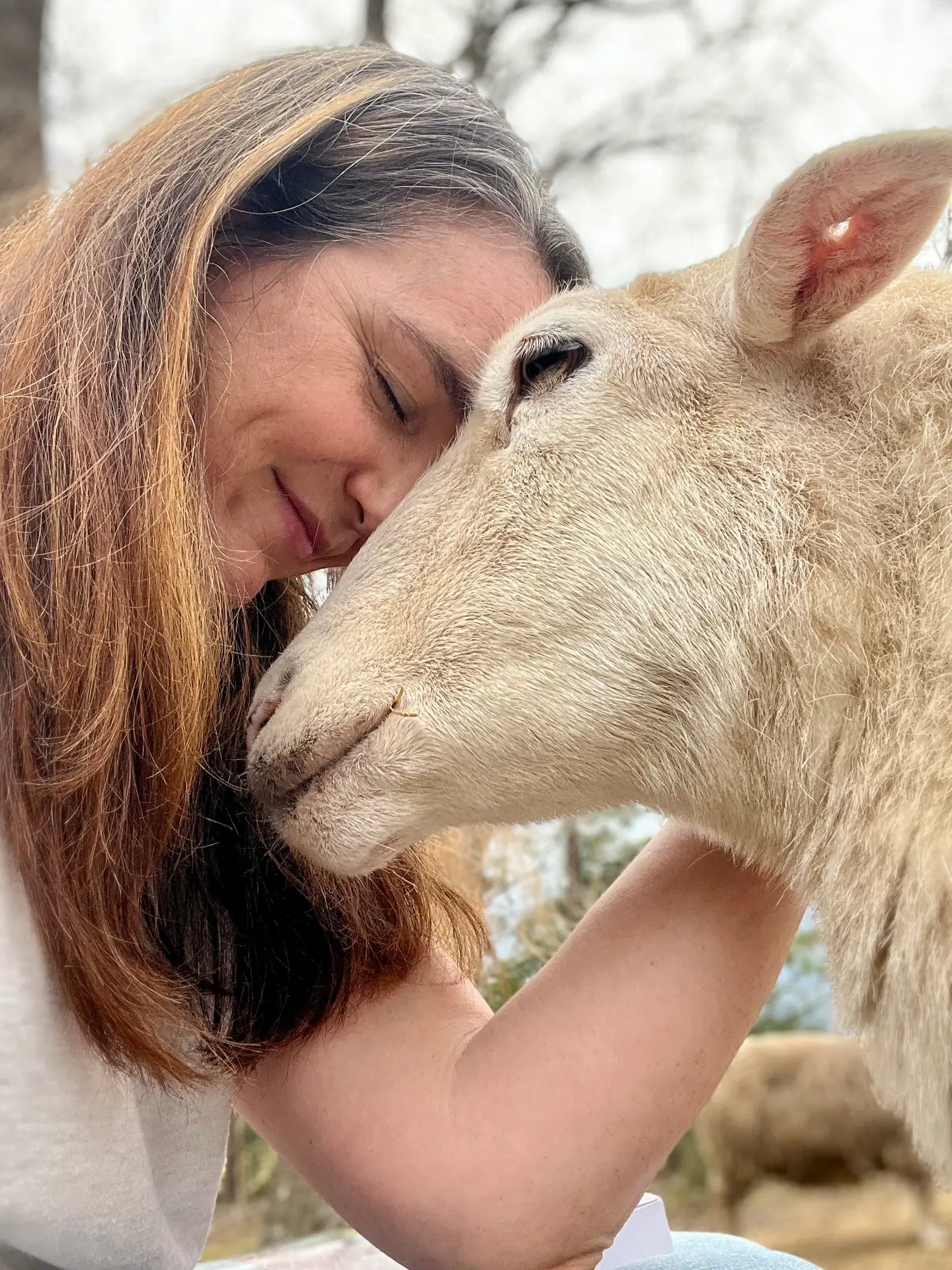
This July, Piedmont Farm Animal Refuge will host its first Leaders for Ethics, Animals, and the Planet [LEAP] program. Kate Altizer, the Refuge’s Education Director, answers some key questions on why high school students should apply to this free, immersive experience.
This post’s featured image is Altizer with Camellia sheep. Camellia was rescued with her daughter, Marigold, from neglect and malnutrition. Both now reside at the Refuge.
Dynestee Fields: Where did the LEAP program originate, and what’s the story behind it?
Kate Altizer: It’s a really moving story. The origins are actually in the love between a high school student and a farmed animal. A pig.
LEAP was founded by three nonprofit sanctuaries in California.
One of them, Blackberry Creek—they received this letter from a high school first-year student [Audori] in Orange County who was taking this FFA, Future Farmers of America, class as an elective.
She was placed in that program, and she was excited about it. She got to raise a pig; she named this pig Sebastian, and then halfway through the semester, the teacher said, “And, by the way, these are animals who are going to be sent to be killed.”
This just disturbed her. Sebastian was her friend. She cared about him, and so what she did was instead decide to save his life. She ran this big crowdfunding campaign so she could purchase him back from the program.
Then she reached out to Blackberry Creek to try to find a forever home for him.
So that’s the inspiration behind the program. Just seeing the way that young people’s love for animals and enthusiasm for them is twisted in this commercial context and wanting to benefit from students’ love without having to turn it for capitalist profit.
Fields: So LEAP is an actual organization?
Altizer: Yes!
LEAP is a national organization. It started small in California, but they’re in multiple states now. If you go onto their website, you can see the different sanctuaries. So what they wanted to do was partner with sanctuaries because a lot of us in sanctuary work think the animals are their own best ambassadors and that spending time with them can really be a game changer. So they wanted to partner with sanctuaries to run these programs where students can have access to animals, work with them, care for them, but again, in a very, very different context than the animal agricultural complex.
As they were working with sanctuaries, they realized that when you’re doing sanctuary work there’s often very little time. Not every sanctuary has a designated education director, and so they wanted to create this curriculum that anyone could pick up and use pretty easily at their sanctuary, adapt to the animals they have there, and [adapt to the sanctuary’s] specific needs. They created this program and this whole curriculum that sanctuaries can participate in.
Fields: What inspired Piedmont Farm Animal Refuge to adopt this program, and was there a specific moment or experience where its need was undeniable?
Altizer: I think the sanctuary had wanted to offer a program for a long time. We have had a summer camp for elementary schools that was not related to LEAP. It was just a program we ran. It’s called Camp Compassion. We’re running it again. It’s a very successful program.
But [the Refuge] had really wanted to tap into LEAP and offer programs for different ages.
As I mentioned, there’s just so much that has to happen at a sanctuary. For many years, it was our founder, and her partner, and our network of volunteers. But as the staff has grown, more things become possible outside of caring for the animals, and fundraising, and that sort of thing.
I think it’s been a long time coming, and now that there’s a designated position, it’s a little easier.
Education is a major part of our mission. We love young people; we believe in their power to be changemakers. So just having someone in this dedicated role to be able to design, organize, [and] facilitate camps has been pretty key, and I think the need has just always been undeniable.
Just like in any kind of nonprofit work or advocacy work, there’s always more need than there are resources, so the need is always there.
Fields: Okay.
While the LEAP program is designed for students who are already invested in animal welfare, how might it capture the interest of students who aren’t familiar with these issues?
Altizer: One of the things I really respect about the LEAP program is how it looked for ways to meet students’ needs that these traditional agricultural programs also met. So, like, the development of leadership skills, public speaking and advocacy skills, and also interests.
So we talk about welfare in the curriculum but also environmental concerns. Talking about environmental despair and hope and actionable things we can do to fight climate change. So there is a strong welfare aspect, but there are STEM-based elements of the curriculum that I think many students will benefit from, in addition to the leadership.
If you do the semester—so they have a summer version, and they have a semester-long version—that one comes with a requirement of service hours, which [are] often things that employers look for, or college applications are asking for, so it meets those needs as well. And this is definitely a program people can point to on their resumes.
I think beyond the future building, employment, education aspect of it, spending time with the animals is something that, whether you’re vegan or not, a lot of people enjoy. Gathering familiarity with them, comfort working with them, the pleasure in being with them. That story about the founding, the pig and the teenager, I think really illustrates the key thing. The animals themselves are often the draw of these programs. Young people are often drawn to them, feel affection for them, feel pleasure in their presence.
These programs can really help them [young people] lean into that by learning about them and learning how to care for them but not being forced to then make that mental twist to see them as a commodity.
Fields: Excellent.
Can you paint a picture of what a typical day in the program will look like for students?
Altizer: Every day will be themed around a different species who we have here. So goats, sheep, chickens and turkeys, ducks and geese, and cows. We’ll have a themed animal for the day.
In the morning when students arrive, we’ll have a welcome activity, but we’ll [then] dive right into animal care. So helping to do some cleaning, helping measuring out food, and feeding, say, the goats.
Our veterinarian has volunteered with our camps in the past. We’re hoping she’ll come back and maybe teach some basic skills about health checks, assessing the everyday health of the animals [and] teaching them [campers] about basic anatomy. There’ll also be social time with the goats: brushing them, maybe helping them get some browse, which is, they have trees in their environment, [and] you can bend the branches down so they can get them. Those sorts of cute social interactions.
So after morning animal care, we’ll have a good hour and a half, two hours for lunch. We have this wonderful volunteer, who is a professional chef and dietitian, who is going to be cooking lunch, so teaching basic culinary skills and preparing these wonderful vegan meals with the students. We’ll take plenty of time to be social around food, and enjoy food, and talk about it, and learn about it.
And then [in] the afternoon…
It could be a lot of different things. [It’ll] probably be some kind of a lesson. It’ll be warm, so maybe something a little less physical. Maybe we’ll have a lesson about pollinators.
One of the unique things about the Refuge is what we call animal-centered design.
So our founder’s partner is an architect, and he combines the principles of design architecture with the question of “What would animals build for themselves if they could?” Based on animal observation, [and] learning about animals’ wild ancestors, he builds these species-specific habitats.
This is one thing that’s special about our sanctuary, and so maybe we’ll have a lesson about “How do you go about designing an environment for a particular animal?”
It’s important to me to end the day with some kind of a processing activity. We certainly don’t expect all of the students to be vegan when they get here or anything like that. Even for those who may be, or may be vegetarian, there’s gonna be a lot coming at them. So having a safe and maybe private way to process the day’s experiences would be really important.
Fields: Is there an activity that you’re particularly excited about, and if so, what makes it special?
Altizer: I’m most excited about the students spending time with animals. There’s nothing that I can teach them that will make more of an impression than Blackberry the Turkey looking into their eyes or trying to climb into their laps. There’s nothing that’s gonna teach them more than that.
In addition to that, I do want to give a shout out to our chef, Leah Jamison. With the elementary schoolers, the cooking portion of camp is always really, really wonderful, and I’m really excited for that, too.
Fields: After the program concludes, how might students concretely apply what they’ve learned?
Altizer: We’re hoping that they’ll take home some basic culinary skills. Some strategies for advocacy in animal welfare spaces but also just generally. If you have an issue you care about, what are some steps you can take to make actionable change?
And [for them] to be inspired to not just see problems, or despair about problems, but think about problems, and think about what your role can be in finding solutions to those problems.
Skills and caring for animals. I expect we’ll have several students who are interested in being veterinarians or some sort of similar track. So that familiarity, and comfort, and skills in doing that.
We also hope that they’ll be very deliberate about their ethics and understand what it might mean to try to live in a way that’s aligned with your own ethical beliefs.
Fields: So as an alternative to programs like 4-H, does the LEAP program provide or connect students with scholarship opportunities?
Altizer: I would like to point out that it is a free program. In other agricultural programs, students might have to purchase feed, equipment, medicine, that kind of thing. So, it’s hopefully pretty accessible in that way.
[However] there is currently no scholarship program for alums of the camp version of LEAP.
Fields: What do you hope the program will look like in 5 years?
Altizer: One of the things I really admire about our founder is that she is very committed to growing sustainably. She’s really thoughtful and intentional about how everything here at the Refuge progresses.
I try to take a page out of her book. What do we need before we can expand these programs and our offerings? One of those things is a really robust network of volunteers.
So I really hope in the next 5 years, we’ll have this built-in network of education volunteers, and hopefully some of them will be alums of the program. What I’d really love to see are people being able to come back from being students to being counselors and stay involved.
So to build a community of folks who have been through the LEAP program at the Refuge [and to] build lasting connections with each other, with us, with the animals. In addition to alums coming back, hopefully they’ll also spread the word with folks in their own networks, including friends and family.
I also hope, on a practical level, that we’ll be able to grow in our offerings to all ages. So right now we have an elementary school camp, and then we have this high school camp. So some gaps in the age-targeted programming that we have would be for middle schoolers, for littles, and then for adults. So hopefully in 5 years, we’ll have some sort of targeted camp programming for all ages.
Fields: Wonderful. So the alums who may come back as education volunteers, what would they be doing?
Altizer: It takes a lot of people to make a camp run well. You need counselors to be there to be mentors, to help set up programs, to help talk through things, process things.
LEAP campers—they don’t have to come back even as education volunteers. I’d love it if they just came back as volunteers. We have several volunteering programs here: general volunteering, animal care volunteering. We have over 100 volunteers at the Refuge, and we really rely on them and are grateful for them. While it would be great if they came back in this capacity, I’d be happy for them to come back in any volunteering capacity.
Fields: For students and their families who are traveling from another city or state, what are some animal-friendly accommodations and attractions in the vicinity of the Refuge?
Altizer: Jenna and Friends Animal Sanctuary is wonderful. They have pigs and recently have built accommodations for roosters. There’s so much need for rooster rescues.
No judgment. But a lot of times if you go to Tractor Supply, and they say, “These are all hens,” it’s really difficult to sex a chick. So then people will get these chicks home, they’ll fall in love with them, and then they’ll start to crow. So there’s a lot of need for roosters, and it’s really special that they have that designated area there.
Carolina Tiger Rescue is also a fantastic organization. They are also accredited, like we are, from the Global Federation of Animal Sanctuaries. Accreditation is really important to us. There’s no legal definition of sanctuary, so there are organizations out there, like roadside zoos, with the name “sanctuary” in their title that don’t necessarily have the same standard of animal care or attitudes towards animals that true sanctuary does. So that’s important to us.
I would also suggest that patronizing local vegan restaurants or vegan-friendly restaurants is an animal-friendly thing to do. We actually have a Triangle Vegan Dining Guide on our website, and there’s a million vegan food trucks in the area, too, which is pretty neat.
Fields: Great. Are there any particular ones that you would highlight?
Altizer: We just had EBN’s Vegan out at one of our tours, and they were great.
She doesn’t have a food truck, but we have worked with the owner of Soul Cocina. She does gluten-free as well, which is very nice. She also caters. She’s wonderful.
A few others I’d love to give a shout-out to: Season It Up, Fresh AF, and Blu Tee Spoon. And she’s not a food truck, but Chef Nikki of Cake Slayer makes the most beautiful and delicious desserts.
Fields: The big question: How does a student apply to the LEAP program, and what should they expect during the application process?
Altizer: It’s an all-online process.
They can either go to the LEAP website and look for us, or they can go to our website and under the “visit tab,” they can look for “New! LEAP Summer Camp,” and that will take them where they need to go. The application ultimately lives on the LEAP website, but they can get there from either direction.
We’ll get a ping when their application comes through, and I’ll respond and send an email just saying we got it.
Students should be prepared to write a few hundred words about why they want to join the program, as well as share some basic information about themselves, and we’ll let folks know within a week or two of applications being closed, but they’re still open for a little while.
Fields: May 29th. That’s the application deadline on the website.
Altizer: Yeah.
Fields: Is there anything that I should have asked but didn’t?
Altizer: I would just encourage students who might see this. If you’re not vegan or even vegan curious, some folks might be concerned that they might be shamed about that if they come here. The Refuge does maintain a vegan food policy out of respect for our animal residents, many of whom have come from traumatic histories as a direct result of our agricultural system, but we are not interested in judgment or shame. That is not our approach here.
We’re interested in sharing accurate information, meeting people where they are, helping young people understand the importance of being deliberate and informed about their ethical perspectives and feel empowered to make choices and changes that they feel good about.
I just don’t want people to worry about that. I want people to know everyone is welcome here. You know, there might be challenges. We might challenge you, but we will also care for you, listen to you, offer you resources, and welcome you into our community.
Fields: Thank you for this interview!
Altizer: Thank you so much. This was a lot of fun.
Leave a Reply