

In 2023, Austin Simmons became an official Vegan Chef Challenge Organizer at Vegan Outreach. Prior to this position, Simmons dedicated himself to reviving the vegan community in Springfield, IL, and expanding vegan options at local restaurants. His work culminated in organizing Springfield’s first Vegan Chef Challenge. Simmons conversed with me about the online comment that inspired him to go vegan, his experiences uniting the Springfield vegan community, and Vegan Outreach’s strategies for improving animal lives. Below is our interview.
This post’s featured image is Austin Simmons holding a Bloomington Vegan Chef Challenge poster.
Dynestee Fields: Looking back, what was your relationship to food before you became vegan? How do you view food now?
Austin Simmons: Before I went vegan, my view on food was very limited. I grew up in the Midwest, which is where I’m from.
When you’re a kid, there’s chicken nuggets, and burgers, and stuff like that. But, things [in the Midwest] are just very limited.
I was almost 15 years old when I went vegan. I was still young, but it really opened up my whole world of food. I started getting curious and trying dishes from different countries. I’ve never had a more expansive view of food since going vegan.
DF: My next question follows that line of thought: Have any individuals, media, or even meals influenced your vegan journey?
AS: I know a lot of influences. Especially early on, I really tried to get as much information as I could from everybody. Since I was about 14 when I went vegan, I did like a lot of YouTubers. So there were people like The Vegan Zombie who were active back then. He [the Vegan Zombie] is still active.
He was pretty cool, and he had some nice recipes. There’s also some other people, like Unnatural Vegan, that I found a little bit later.
And she had more of a science-based kind of approach to a lot of this stuff, and she’d actually reference people like Jack Norris, our nonprofit director, as well as some others.
Of course, there’s the raw foods side of veganism. Then there’s the scientific side; they’re not necessarily one or the other. I like to eat healthy whole foods too. But I really did like that approach of being very pragmatic.
Regarding activism, I was very interested in it. But I just didn’t really have a lot of great role models very early on. So I mostly just watched content. Eventually I found people like Earthling Ed.
I really did like the pragmatic approach and all those recipe videos. That content available online really made the transition very easy for me, and I’ve been able to keep it up for over 10 years now.
DF: That’s terrific news! A lot of online content makes it easy for people to transition!
AS: Especially here, [where] there’s no vegan restaurants. Or, [where] I didn’t have any vegans I knew. No vegetarians or anything. I was really a lone wolf growing up, trying to figure this out myself. It really did make it a lot easier by having places to go and connect with people virtually.
DF: That does make it a lot easier to have that community.
AS: Definitely.
DF: So how have you been active in the vegan movement? Are there any moments that are particularly meaningful to you?
AS: I mainly got started, I guess in about 2021, and it just got to a point where I was tired of not knowing any other vegans. Like I said, I didn’t know anybody locally. We had a Facebook group here that wasn’t super active, so I figured, “Let’s start doing regular restaurant meet-ups.” And I started to do food meet-ups at restaurants that are kind of vegan-friendly locally.
And our first meeting, surprisingly, had 11 people show up. I didn’t know a single person; so, we were all strangers. We got to know each other and talk.
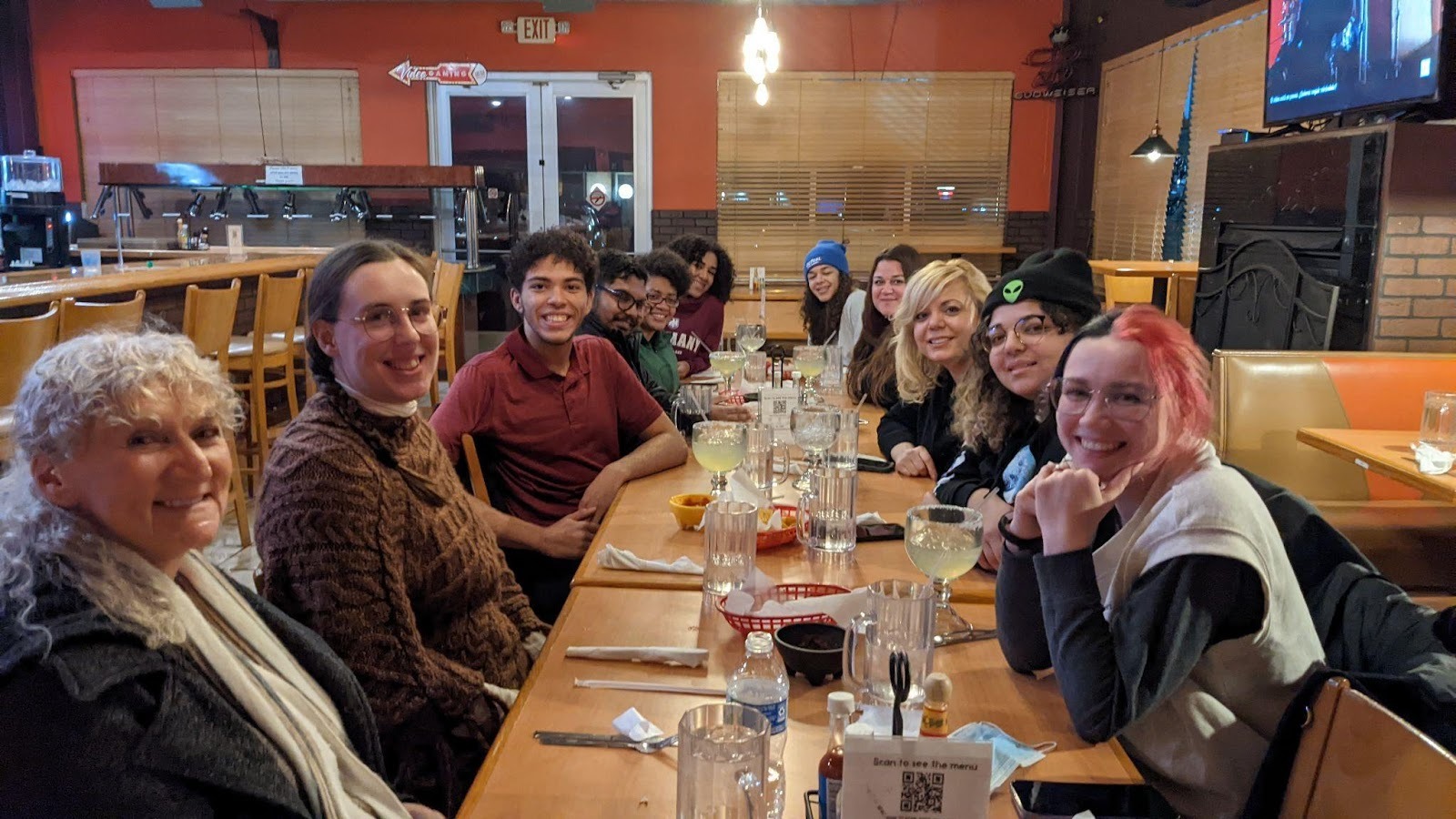
The first Springfield, IL Vegetarians and Vegans meeting at La Fiesta Chatham
We have several people from that very first meet-up that still come to our monthly food meet-ups. And we went from having 11 people to, sometimes, buffets with 70 people. This is a smallish town that just never saw anything like that before.
That’s kind of how I got started being more active; it was really through food.
Now, where I live in Springfield, IL, we really do have a lot of vegan-friendly restaurants where there were none previously.
We’ll probably get to this more later, but that’s what led to me wanting to organize our first Vegan Chef Challenge here. Now I have the position to be able to do that in other cities across the Midwest, and even in Greenville [South Carolina], like we did recently.
DF: So you coordinated the first meet-up at the restaurants for your vegan group?
AS: I started the vegan group here since there was not much going on. So I started the Facebook page and everything. We just made a Facebook event, we had a Google form for people to save their seat, and I called up the restaurant. It was really that easy just to get it all set up.
We really pushed on Facebook to get the word out, and that’s how it got all those people initially.
DF: Do you think that this contributed to more vegan restaurants popping up in the area?
AS: Definitely. So we haven’t had a fully vegan restaurant yet, but I think we’re getting the conditions where that’s more feasible. But we went from having really no notable vegan options in town to now. If I want to go out to eat, there’s a dozen different places that I know I can get very good options. Even more than that have joined our previous Vegan Chef Challenges, and we’ll on occasion have some very exciting options available.
DF: This all took place in Springfield, IL?
AS: Yeah. That’s where I’m from, so I started there. So the actual Vegan Chef Challenge program, we have these events all around the country. I joined Vegan Outreach in 2023. It was actually my second year anniversary on September 1st, so that came up recently.
DF: Wonderful. So what was the name of your initial Facebook group?
AS: The group is just called Springfield, IL Vegetarians and Vegans. I did work with another nonprofit to help. We have a bigger Facebook page. How Facebook works is you have your public page, and then you have your private group, and you can’t run ads for just groups. So that other nonprofit did help us with getting the word out and everything too.
DF: Nice. It was a collaborative effort. What’s the nonprofit?
AS: So that was with Project Animal Freedom. They helped us get that Facebook page started. So I worked with them to do that.
DF: Awesome. So what is the inspiration behind the Vegan Chef Challenge? How did you become its organizer?
AS: We have a couple organizers for the Vegan Chef Challenge program, but what I can say is it started in 2010, actually over on the East Coast in North Carolina.
The activist there, I think [she was] in a pretty similar situation as me: just tired of not having good vegan options available and wanting to have more at restaurants.
For all of us, it really comes from a sense of not just being about the food. We care about the animals too.
Everybody looks at what happens in factory farms to these animals, and nobody wants to support it. Even the most regular meat eaters will say that they disagree with factory farming. But that’s the only way for us to eat meat three times a day. There’s no other way to supply that much animal-based food.
So part of it is a culinary interest, but the bigger part is we really just want to help animals and tell people that you don’t have to be fully vegan to make a difference. What if everybody just regularly ate vegan foods on occasion? That would make a huge impact, even if they didn’t go fully vegan.
Anyway, she [the activist] started the event there [North Carolina]. It was so successful that over on the West Coast, in Sacramento, another activist heard about the event. She [the activist in Sacramento] took it up there. I believe the Sacramento Vegan Chef Challenge is in its 15th year, or it’s nearing its 15th year. Every year, they have more and more restaurants participate.
When we think of California, we probably think of it as a vegan heaven; there’s everything there. But Sacramento, specifically, didn’t really stand out very much for its vegan options. But with the event happening every year, and the restaurants innovating on it, it just got bigger and bigger.
Sacramento’s [now] one of the most vegan-friendly cities there. So, it really did do very well. Since then, Vegan Outreach has taken up the program and works with those original organizers.
I heard about the event being successful in other cities. So of course, me, somebody that wanted to see vegan options take off in my city, organized one as a volunteer.
Luckily enough, our first event in Springfield had about 20 restaurants that participated, which was really amazing. Luckily, there was a job opening at Vegan Outreach to organize this in some other cities.
Since I was brought on board in 2023, I’ve now organized almost 15 Chef Challenges around the country. It’s just really cool seeing how that impact has grown and grown over the years.
DF: So are the other organizers still helping out with the movement, or is it centralized with you all?
AS: I worked with the Sacramento organizers to get the event in some other cities.
In Sacramento, I know some of the original organizing team does help with that. But, it’s mainly on that city’s basis, just since it’s so much work to put these events on. Most volunteers really only have time to help with their local cities. But they [the original Sacramento organizing team] were super helpful with getting all the support we needed to get the program nationwide.
I think that’s mainly their focus: their own city, at this point.
DF: What are the names of the original two organizers [from North Carolina and Sacramento]? Can you share them?
AS: I wish I could. I don’t remember off the top of my head, just since it was before I was with the nonprofit. But I think on our website, veganchefchallenge.org, there’s a FAQ [Frequently Asked Questions section]. It may list their names there. I just don’t know off the top of my head.
DF: That’s okay. I also want to ask if you became vegan for the animals. It seems like you were concerned about factory farming?
AS: You got it right. For me, it was all about the animals. Of course, later you learn there’s some health benefits and environmental benefits. But, really that’s what made me so passionate about it. I was on the internet, and I saw a news article on the Yulin Dog Festival.
If you’re not aware, sorry to inform you about it, but they eat dogs in China.
That sounded kind of horrifying, but there’s a lot of bad news stories that we hear about. So I would have just scrolled past it like anything else. But what I saw in the comments of that news article was somebody said, “If eating dogs in China is wrong, then eating cows, pigs, and chickens in America should be wrong too.” And then it said to go vegan.
For me, I didn’t even know what the word vegan meant. I kind of knew it was associated with not eating meat, but I didn’t know any details. So that’s when I started searching for more information on it.
That led me to looking more into what animals go through as standard practice on these farms. Even the mom-and-pop organic [farms], the really nice farms, still do a lot of the same practices.
Mother cows, the only way they produce milk is if they are a mother. Their babies are taken away each year so we can take the milk. No matter how kindly you do that, that’s still us separating a mother and a child. It’s really devastating for them.
Then, what do you do with the baby? Even if you’re a really nice farmer, you can’t have new babies every single year if you’re not gonna do something with the baby.
A lot of times they go to veal. Or they become dairy cows themselves. Or they just go straight to beef. Finally, what happens to the dairy cow when its production declines? You have to do something with her. A lot of times, they are going to beef too.
So I was learning about all that kind of stuff early on. When I also saw how easy it was to be vegan today, even in my city with no vegan options or vegan restaurants, it really was a no-brainer. It’s like, why would I want to support all of this if I didn’t need to?
I was pretty dedicated. I actually was able to go vegan overnight, which isn’t super common.
A lot of times, people do need a transition period. But for me, it just was so wrong. I had all the information I needed to make that decision, and really, I was lucky enough to have all the information because I didn’t run into any health issues. I didn’t run into any issues finding food to eat. It was a pretty quick switch for me, and I’m really happy I was able to do that.
DF: Wonderful. You’re very pioneering.
AS: Thank you.
DF: So what is a typical day for you as an organizer?
AS: So when I’m organizing a Vegan Chef Challenge, most of the time is used up inviting chefs. That can be anything, [including] actually visiting in person.
So, I’ll travel to most of the cities that I do organize in. Greenville is the one I wasn’t able to, just because of the distance, but fortunately we had some really good, local volunteers that helped us make that one happen.
So I’m either going to the city to give them physical folders that have information on what vegan food is and what the event is all about, or I’m more often on the computer trying to send out Facebook messages and phone calls. Our team will send out emails and things like that.
That’s what a lot of the time does end up going towards.
DF: So do you end up traveling a lot to cities closer to you?
AS: Really anywhere within about 5 hours I’ll make a trip to. For each event, I’ll usually only go a couple times.
We had a Bloomington, IL, Vegan Chef Challenge I did, and since that one’s not too far away, I went to invite chefs in person. I’ll try to plan out as many restaurants as I can in one go, and I’ll spend all day talking to chefs.
But also, I delivered the table, tents, and supplies for that because restaurants will have posters and things that tell diners where to vote.
Then there was a third time I went. I’m trying to remember off the top of my head. I think that was actually a leafleting trip. So I also visit local colleges that educate students about veganism and also what animals go through. But since that was the Vegan Chef Challenge city, we handed out information on the Vegan Chef Challenge happening too. So in that instance, I was able to go a few times.

A Bloomington, IL, Vegan Chef Challenge newspaper article
DF: So when it comes to leafleting, how does that take place? Are there tables that are set up that volunteers are running who are already affiliated with the college? Or do they just allow you all to come in?
AS: It’s actually a very great program.
I’m trying to remember the founding year. But for over 30 years, Vegan Outreach has been doing these leafleting events. So, there’s a rich history of it. Essentially at any public university you have freedom of speech and protection. So if you want to speak about something, you can, as long as you’re not getting in the way of people or anything like that. We’re always very friendly, and I’m always surprised at the positive response we get.
For me, I started leafleting more this year. So I added that in with the Vegan Chef Challenges that I organize. What I’ll do is plan a school I want to visit. I’ll find some volunteers that want to help with it too. Essentially, we just head out during the busy times, usually around 10 a.m. to 2 p.m, and our goal is just to hand out as many of those leaflets as we can.
It’s hard to say how many leaflets you have to hand out to make a difference, but you definitely do. What’s always cool is seeing people read the leaflets as they walk on. Sometimes they’ll come back with questions, and that’s always fun, too, when they want to talk more about what’s in the leaflets.
We have a website called adoptacollege.org, and that actually lists local schools. You can see notes from previous leafleting trips people went on. You can also see what the record was for how many were handed out in one day. That’s a pretty useful way for planning these leafleting events.
DF: Wonderful! So do restaurants readily participate, or have there been challenges? If so, what approaches have you used to overcome these?
AS: That’s a good question because there’s a lot of challenges sometimes, but it’s kind of interesting. It’s so hard to predict because you would think the vegan restaurants would be the easiest to get on board. Then the very meat-heavy restaurant with no vegan options would be the hardest. But in my experience, that isn’t necessarily the case.
Sometimes I’ll look at a city, and I know that there’s vegan restaurants there. I know that there might even be a vegan group. I think, “Alright, we’re gonna get them on board. Then we’re gonna branch out, and we’ll try to get some of the harder-to-get restaurants because those nonvegan businesses make the biggest impact whenever they add vegan dishes to the menu.”
But sometimes it doesn’t work that way, and it does just take a lot of time and follow-up. Especially right now. All businesses are struggling but especially restaurants. The prices of their ingredients are going up and diners are getting out less, so they might be a little stressed because of that. Also, they might have other events going on. And on top of all of it, just running a restaurant itself is a very time-consuming line of work. It’s probably one of the busiest types of businesses you can run.
So even if somebody’s on board, we might have to follow up three, four, five, or sometimes even more times to get them on board for the event.
But it really is always a surprise, and I try not to count out any business. I always invite any local business that looks like they may be open to adding some dishes to the menu.
Like I said, it’s hard to predict. But when you do follow up with them, they, oftentimes, surprise you, and you get some really neat businesses on board. And sometimes the restaurants that add the most unique dishes are ones that you never expect. So that’s why I always try to be persistent and always respectful of their time.
We do see some neat businesses join that way.
DF: How do you gauge a restaurant’s probability of participating?
AS: Mainly what I look at is a few things. Like if they’re a newer business, it’s always great to go invite them. Just because they’re trying to get their name out. They want to be part of the community. Our event is really good at just bringing the community together, whether or not they even care about vegan food themselves. So that’s one criteria that’s good.
Another thing, too, is if they’re already kind of engaged with the community. So if they’re active on social media, that could be a good sign.
If they do regular specials, that can be a good sign too. Because, it shows that they’re a more creative chef. So they like the challenge of coming up with new dishes and things like that.
Like I said, I never count out any business. But if it’s a very traditional restaurant…say it’s an Italian restaurant, and they’ve got spaghetti and meatballs, and maybe pizza, but not very much variability in it…sometimes they’re tougher to get to join because that may not be what they’re interested in. They just want to run the business. They’re not looking to really branch out or try new things.
So I really do like to look for those creative chefs. Those are really the ones that do very well.
DF: Overall, restaurants are invited to participate in the Challenge? Or are there any opportunities for them to sign up somewhere?
AS: So our website for the event will have the chef sign up link so restaurants can join. We’re pretty open to all types of businesses to participate. Here in Springfield, there was a non-alcoholic bar that joined. They didn’t even really do food; they just did drinks.
I think their first year, they might have added a curry dip for pita chips. So they did add a food item. But really, they competed with their non-alcoholic drinks. They did very well because of that.
I believe in Greenville, last year, there was a laundromat that joined. I’m trying to remember the business name, but it really surprised a lot of people. It’s like a laundromat that also has a restaurant attached to it, and they got a lot of media attention and stuff too.
So really all types of businesses can join. We’ll try to invite restaurants we think would be a good fit, but we also don’t say no if they want to join the event and add vegan dishes. Of course we want them to participate too.
DF: Wonderful. I’m gonna have to look up the laundromat restaurant. That’s a very creative approach.
AS: Yeah. Yeah.
I wish I remembered the name. But I remember it got a lot of attention, and it was actually a different organizer that did the Greenville event last year because he was local there. He since went on to do more leafleting, so he’s focusing more on doing the college student outreach.
I wanted to make sure the Greenville Vegan Chef Challenges could continue, and that’s why I took it on remotely. But I remember him sharing with all of us that he did get a laundromat to join, and all of us were like, “What? There’s a laundromat that serves food?” And there was. And if you think about it, if you’re at a laundromat, what better way to spend the time than eating good vegan dishes?
DF: That’s a step up from the vending machines that a lot of them have.
AS: Yep.
DF: Awesome. So what was the name of the organizer in Greenville?
AS: So last year’s organizer, his name was Yuri. He’s the one that since went on to do some more college outreach. He’s been with Vegan Outreach for 11 years, just recently. So he’s super cool, and I actually met up with him just a couple weeks ago to leaflet in St. Louis. So both of us drove over there, and I think we handed out a few thousand with our whole team.
DF: Thank you for sharing that.
AS: Yeah.
DF: That’s quite an accomplishment.
AS: He travels the whole country. Also, this year, something interesting with him is he went from Florida all the way up to Maine and visited over 70 schools just for the spring semester. So he’s super dedicated, and I don’t know how he does it. He’s certainly had a huge impact for the animals.
DF: Wow. So how is the impact of the Vegan Chef Challenge measured?
AS: So we look at a few different metrics on making sure that we’re really having a good impact on communities. One thing we do look at is how many nonvegan businesses participated. Just the fact that they aren’t a vegan business, and they joined to add new vegan dishes to the menu, that in of itself is a big impact. Everybody that orders those dishes could have ordered meat, but instead they ordered something that was animal-free. So that’s one thing we look at, and another is how many actually kept their menu after the event ended.
That statistic sometimes is a little difficult to confirm just because sometimes they’ll keep the menu options but not tell us. So we have to call them up or email them. Sometimes we just don’t get to them.
It can really depend on the event, but even a few months out, it’s pretty common for at least a quarter of restaurants to have their Vegan Chef Challenge dishes on the menu. But sometimes it’s a lot more. Over half of the restaurants in some of my cities have kept their dishes months after the event ended. We really like to see the amount of vegan options expanding in cities. So places like Springfield, where we didn’t have really any notable vegan options.
Any of the previous Vegan Chef Challenge participants—those are the ones I look to, even when there’s not a Challenge going on, because I know that they’re still gonna have good dishes on the menu.
Another thing we’ll look at, too, is how many votes we got in. Recently, we’re starting to track more of what the diets of the people voting have been. Since we added that question to the voter form, it’s been pretty interesting to see that most of the votes coming in are from nonvegans.
It’s hard to say an exact number. But sometimes it’s about a quarter of the votes come from vegans, sometimes a little bit more than that. We especially like to see nonvegans participating, too, because a big part of how the event actually affects animals is when we’re showing meat eaters that “No, you can have a vegan dinner and not be hungry and not feel like you missed out on anything. In fact, maybe you get to try something new and exciting.” When they leave with that impact, they’re more likely to choose vegan options in the future. Or, maybe even consider going vegan themselves. So those are all ways that we like to measure our impact and numbers.
DF: I wonder what’s driving nonvegans to try out the menu items from the Vegan Chef Challenge.
AS: So I’ve actually got a chance to meet some of them here in Springfield. We did a raffle just for the voters. I know a lot of people locally, and I didn’t remember them [raffle winner] as a vegan. When I handed them the raffle prize, they said they were a nonvegan, and I asked, “What got you interested in the event?” They said they just loved the restaurant, and they wanted to try their new dishes.
So, sometimes it’s as simple as that. They already know the chef, and they’re excited to try what they come up with. I think that’s probably pretty common.
Also, a lot of times we’ll do radio interviews or sometimes TV interviews. So they might hear about it from sources like that.
And I don’t know. If you’re already nearby one of the restaurants, or you already know of them, it’s just interesting if you’re used to getting the same thing. Why not try something new? And if you hear other people are talking positively about it, maybe that’ll inspire you to try it too.
So I think that’s probably the main way that nonvegans will get interested in them.
DF: Fascinating. What’s wrong with being adventurous? You’ll probably have a good time if you branch out and try something.
AS: Yeah. Exactly.
DF: Have any restaurants experienced significant transformation due to the Challenge? If so, is there a standout story of this?
AS: So this is one of those hard questions, just because there’s so many examples I could probably think of. It’s like, what’s a good one?
I do know, overall, it’s always neat going back to these restaurants after the event ends. Months later. First of all, most of them have the awards up still. So I’ve come back a year after the event ends to invite them for the next year’s event. You’ll see they’ve got their award hung up. Like, it’s their most prominent award for having the Best Dessert or something. So, that’s always neat.

El Paraiso’s award, from the 2023 Champaign Vegan Chef Challenge, displayed over a year later
I know here in Springfield, we have a restaurant called La Fiesta Chatham, and they previously had good vegan options. They’re actually who I went to for our first vegan food meet-up when I was just getting people involved with restaurants.
They’ve really expanded it [their menu] since the event and their first Best Entree dish.
It’s still on the menu, and they actually list it on the menu as winning the 2023 Springfield Vegan Chef Challenge. So it is neat that they really make use of the popularity they got during the event, and they’re still successful months and years later. Since then, they’ve only grown in the amount of vegan options they have.
I think the big thing is, we just see restaurants really taking vegan options more seriously.
It’s not an afterthought for them anymore. Even when the event’s not going on—I think I saw a restaurant in Greenville doing this, they just added new vegan dishes to show off to the community.
So it really creates a buzz during the event, but that continues long after it ends too.
DF: So what prize do the winning restaurants receive? You said they had their award on the wall. So what is a prize?
AS: So our three top-voted restaurants, they get a framed certificate with their award. So we’ll say, like, Best Chef 1st place, 2nd place, 3rd place.
But also, a lot of times they’ll get a second award too. So I might say, Best Overall Menu, that’s what Vegan House Shack got in Greenville, or it might be something like Best Entree or Best Appetizer. So we awarded those. Even if you weren’t the most voted restaurant, some of the smaller businesses can still stand out for getting awards. Like, the Best Value Option, that One Love Fusion Foods got in Greenville. Since they’re a food truck, it was a little bit harder for them to compete on numbers. But they still stood out for that.
The other things that the top-voted restaurants will get are VCC [Vegan Chef Challenge] winner aprons. So it’ll say that they’re a winner of the Challenge, and it’s a big apron they can wear.
We’ll also have prizes from companies like Just Egg, or sometimes local businesses will donate. Just Egg donated a food service case to our winner this year.
They’ve been very great with donating prizes like that.
DF: Did they donate it to the winner in Springfield, or just anywhere in the country?
AS: Just Egg actually has sponsored pretty much all of our Vegan Chef Challenges around the country, so they’ll give the top-voted restaurant either Just Egg Folded or the Liquid Egg Prize. It’s my favorite vegan egg anyway, so it’s always fun to get to promote them because of that.
We also have some other businesses too. I’m trying to know how to pronounce it, but it’s T-C-H-O. So it’s TCHO Chocolate.
They make vegan milk chocolates, and they donated a prize to our Best Dessert award winner too. So they’re a little bit more selective on which events that they’re doing, but they’re still getting a prize out to them too.
DF: So do all the restaurants compete against others in their city? Or is there something on a national level as well: where they’re competing against the winners from each city?
AS: That’d be a cool event idea: having the National Vegan Chef Challenge. But it’s mainly just within the city. So when the Greenville Vegan Chef Challenge wrapped up, we tallied up all the votes that diners casted for the restaurants in that city. Then all the prizes are based on that city. So it’d be, like, the Best Entree for that year’s event.
DF: In what ways do restaurants impact perceptions of veganism in their community? And do you have a story about this?
AS: It really gets people talking and participating more in veganism in general.
One of the groups that I’ve really enjoyed working with is Vegetarians in Motion, and it’s the local vegan group in Rockford, IL. So, I really didn’t know a lot about Rockford before I organized the Vegan Chef Challenge there, but I connected with them early on.
And it was just a group of really cool activists, you know? They’re in it for the animals, they also care about health, and some of the other benefits with veganism.
But they really did so well at getting the event off the ground, and then expanding our reach out to the other events [Vegan Chef Challenges] too. I feel like since that first Vegan Chef Challenge that I worked with them to organize, we’ve really seen more engagement. So, some of the volunteers that helped me put that event together seem like they’ve been more close since our first Chef Challenge.
We’ve also seen more chefs that are interested in that local vegan community. So, there was one hotel chef, and his name was Chef Jonathon, and he did a really great vegan menu for the event one year. Then, even when there wasn’t a Chef Challenge going on, he was very involved with promoting new vegan dishes. He also did a vegan cooking class, where he was showing people how to make vegan food because he’s a chef. But he wasn’t a vegan chef.
Since then, he’s gotten a lot more interested in veganism, not just for the culinary reasons but also the ethical reasons too. He really wants to promote vegan food for those reasons.
Then he joined the next year at a new hotel restaurant, and he came out with even more delicious vegan options too.
So in between the years, we’re seeing the chefs really take more of an interest in veganism, sometimes even for the animal reasons, and also the volunteers of previous year’s events, and even the diners. That’s always really cool for me to see in between the Chef Challenges happening.
DF: Fascinating! That’s an interesting perspective! Thank you for sharing that.
AS: Absolutely.
DF: Vegan Outreach envisions a future when sentient animals are no longer exploited as commodities. How do Vegan Chef Challenges complement other forms of animal advocacy?
AS: I think it all really goes together, you know? We need as many vegans doing whatever they can to help the animals. So if you’re an artist, do art. If you love food, maybe become a chef or try to get people into vegan restaurants.
I’m not a very good chef, so I try to get people to other—better—chefs making vegan food, and that’s kind of where I’ve tried to make my focus.
Vegan Outreach does a lot of different things, so the Vegan Chef Challenge program is just one of the many things we do.
We also have our college leafleting that we do, and we’re starting to do more of that this year. It kind of dwindled down with COVID, but we’re really trying to bring it back. Like I said, Yuri himself went to over 70 schools just in the spring semester.
I’m trying to go to at least a couple a month too. We’re looking for volunteers to help with that. So our adoptacollege.org website lists the schools and how to get started there.
We’re trying to educate people on what animals go through, and also, how easy it is to go vegan today. I think throughout all the things that we do, we try to make it clear that what animals go through on farms is terrible for them, and we want to try to move away from that the best we can.
Going vegan is the best thing for all of us to strive for, and it’s the best way we can individually make a difference.
But we also don’t want people to think that that needs to be a hurdle. So if you are busy with life, you don’t have the time to look up new recipes. If you just don’t feel like you’re ready to make the jump to go vegan, that’s okay. We’re actually more excited to see nonvegans participate in things like our Vegan Chef Challenges because it really shows that we’re getting our reach out to the people that need it and people that otherwise wouldn’t be eating vegan food.
So we really try to make it clear that you can make a difference even with one meal: if you commit to having a vegan breakfast or a vegan lunch every day, or maybe you commit to no longer eating beef because you really love Beyond Beef and Impossible Beef, or maybe you’re making your own vegan beef substitute and that [beef] is easy for you to give up for the sake of the animals. We want to encourage people to do that too. So we’re trying to help people make steps that make the transition realistic for them, and I think we’ve had a lot of success with that approach.
DF: Awesome. So if you could dream big, what would the Vegan Chef Challenge look like in 10 years?
AS: That’s a good question. So I think in 10 years, it’d be really cool to see more volunteers.
I guess we go to some of the same cities repeatedly. We do that if it was very successful. So, we wanted to go back to Greenville because it had a lot of media attention and a lot of diners voting.
What’s really cool is to see those local communities grow. So what I really would like to see is us continuing to do that because if the local community is strong, doing that next year’s event is a lot easier and has a lot bigger of an impact. I think we’re already starting to see that. But if we can continue to help those communities grow, we’re gonna do even better.
Rockford, that I mentioned earlier—that vegan community’s only gotten bigger since we started doing the Chef Challenge there. I know here in Springfield, this is where I live, so I can see the impact more firsthand. We’ve definitely seen a lot more vegan options at our restaurants and everything.
As much as we can inspire more people to just be interested in supporting the vegan community day-to-day, in between the Vegan Chef Challenges, I think that we’ll be doing pretty good in 10 years on our impact with it.
DF: Have you spoken with someone who was a nonvegan and who tried the dishes from the Chef Challenge and then later became vegan?
AS: So I’m trying to think off the top of my head, and the difficult thing is sometimes we don’t get to follow up with the diners as well as the chefs.
So I’m trying to think off the top of my head on a diner that did. I know a chef [Adam Maas] here in Springfield, again, because I live here, and I can talk to him more. He wasn’t vegan at all. But because of our first Vegan Chef Challenge that he was a part of, he said he was very interested, he wanted to take a deep dive into veganism, and he committed to going vegan for the whole month of that first Vegan Chef Challenge. So that really got him interested in all that. Unfortunately, he had to close the restaurant, I think.
His family was from a different area, and they’re traveling. So I haven’t been able to keep up with them very well. But seeing him really take it on and not just want to throw a vegan option out there for us to vote on and then forget about it—he actually wanted to go vegan himself and see if it could help his health and see what other culinary ideas he could come up with. I thought it was very impactful.
That other chef, too: Chef Jonathon, I mentioned, in Rockford.
Just talking with him, he genuinely cared about the animals, almost on a spiritual level. He really appreciated what the vegan community there is doing for animals. He’s definitely taken a big liking to vegan food because of that too.
If the chefs are doing that, you gotta imagine the diners are too. It’s just hard for us to follow up with them sometimes long after the event.
DF: I didn’t think about how impactful it could have been on the chefs themselves because they know how to cook these recipes.
AS: For them, it’s almost more interesting. One restaurant I was talking to, he [the chef] didn’t join the previous year’s event. This was in Bloomington, IL. I was going to invite him to this year’s event.

Simmons and the owner of Signature Cafe hold the 2025 Bloomington Vegan Chef Challenge poster. Signature Cafe went on to win the most votes in that event.
He said he heard about it, and he thought it was very interesting because vegan food is really, as a chef, very interesting to make. Because if you want to make, like a steak, you’re gonna order beef. Then you throw it on the grill; you might have your seasonings and stuff. But when you step out of that box, it’s like taking yellow off the color wheel.
It’s like, what other art can we make with this? It really gets them thinking, and you can come up with different things if you are a really talented chef. You could make meat out of seitan, vital wheat gluten, and using all these different flavorings.
I think they [chefs] really like it from that culinary perspective. It really challenges them more, and it gives them more creativity and more creative freedom to come up with things that they would otherwise not ever think to make.
DF: Many people want to help animals but are unsure how. What advice would you give to someone exploring advocacy?
AS: There’s a lot of different ways that you can help animals. Like I said earlier, we need every vegan to do whatever they want to do to help animals. So if you’re already good at music, make vegan music. I think really the trick with anything that you do is you gotta actually be good at what that thing is, and veganism is something to do with it.
We all know Joaquin Phoenix. He narrated Earthlings. But also, he’s a great actor, and he plays the Joker. So, it [veganism] is not his whole identity; he’s a whole human, and he is very talented at being an actor. But he also will advocate for the animals when he’s able to do so, and he’s able to make a big impact because of that.
As for what you can do in your own city, I think Vegan Outreach has a lot of different good programs to help.
With Vegan Chef Challenges, I started as a volunteer because I wanted to see vegan options take off in my city. We still support volunteers who want to do that. If you decide you want to do so, we have a coordinator named Birdie. She’s super organized; super, super awesome and friendly; and she’ll help you every step of the way with how to invite the chefs and make sure you have the materials. You know, we cover all the big costs for everybody. So if you do want to do that, you can get in touch with us. Email me at austins@veganoutreach.org. Or just visit our website. You can click around, and you’ll be able to start a Vegan Chef Challenge there.
Also with the college outreach, that’s something that’s happening more too. It really is as simple as handing out the leaflet and just saying info to help animals.You might be a little nervous at first, but once you get a couple out it’s no big deal. It’s totally within your right to speak respectfully there [public universities and colleges], and that’s all we’re doing. We’re handing out info about animals, and that’s a really fun way to make a difference. If you go to adoptacollege.org, there’s a tutorial video. They go through the steps on how to plan a leafleting session.
We’ll send you the leaflets pretty affordably, and you might even be able to team up with another organizer, like me or Yuri, because we are going to a lot of schools in the area. So you might even be able to team up with somebody else to do that.
And then finally, we have a program called 10 Weeks to Vegan. That’s a really good online program. It sends you emails on basic recipes; you’ll learn about all the different farm animals you’re saving and also some habit change tips. So, a lot of the same tips that you would need to, like, quit smoking or, like, do other things that actually apply with changing your diet too.
There’s information about all that, as well as a support group to help people. If you go to 10weeks.org, you can sign up for that yourself, or you can send that link to other people that you think might be interested in transitioning into a vegan lifestyle.
DF: That’s a really helpful resource because I’m sure a lot of us know people who say, “Oh, you know, I really would like to try out veganism. What’s it about, or how could I learn more?” And that’s a good way to just segue them over into a bountiful resource.
AS: I remember when I was doing my local organizing, I was always looking, like, “Man, there’s gotta be a good email series, or, you know, something we could direct people towards.” I looked up a few different ones, and all of them are pretty good. But I really like ours just because it’s very research-focused, but it’s also very, very understandable. So you’re not looking at scientific articles. You’re looking at easier recipes, and all of a sudden you could throw [them] in the microwave real quick.
It’s sprinkling in what the best researchers know about habit change. All of our experience as long-term vegans, you’re getting those tips to make your life easier. So even me as a long-term vegan, I signed up for it again just recently. I’m learning new tips just going through it, so it’s really good for everybody to take a look at.
DF: Excellent! Are there any questions that I should have asked but didn’t?
AS: No, I think you asked a lot of good questions. I think I shared the links there and everything. If people want to connect more with our nonprofit, just in general, you can go to veganoutreach.org. We also have very active social media.
You’re gonna see information about all those things I listed on our website and our social media. So if you forgot the 10 Weeks to Vegan link again, you can find it all there.
DF: Thank you for sharing this valuable information!
AS: Absolutely! Thanks so much for reaching out.
Leave a Reply